


Page 43 - TD-3-3
P. 43
Tumor Discovery                                                    LncRNA HA117 in osteosarcoma regulation


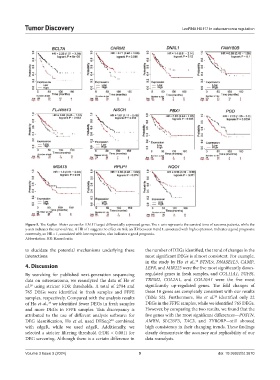
            Figure 5. The Kaplan–Meier curves for HA117 target differentially expressed genes. The x-axis represents the survival time of sarcoma patients, while the
            y-axis indicates the survival rate. A HR of 1 suggests no effect on risk; an HR between 0 and 1, associated with high expression, indicates a good prognosis;
            conversely, an HR > 1, associated with low expression, also indicates a good prognosis.
            Abbreviation: HR: Hazard ratio.

            to elucidate the potential mechanisms underlying these   the number of DEGs identified, the trend of changes in the
            interactions.                                      most significant DEGs is almost consistent. For example,
                                                               in the study by Ho et al.,  BTNL9, DNASE1L3, CAMP,
                                                                                    28
            4. Discussion                                      LEPR, and MIR223 were the five most significantly down-
            By searching for published next-generation sequencing   regulated genes in fresh samples, and COL11A1, TGFBI,
            data  on osteosarcoma,  we reanalyzed the data of Ho  et   TREM2,  COL2A1,  and  COL10A1  were  the  five  most
              28
            al.  using stricter FDR thresholds. A  total of 2794 and   significantly  up-regulated genes.  The  fold changes of
            765 DEGs were identified in fresh samples and FFPE   these 10 genes are completely consistent with our results
            samples, respectively. Compared with the analysis results   (Table S2). Furthermore,  Ho  et al.  identified only 22
                                                                                            28
            of Ho et al.,  we identified fewer DEGs in fresh samples   DEGs in the FFPE samples, while we identified 765 DEGs.
                      28
            and more DEGs in FFPE samples. This discrepancy is   However, by comparing the two results, we found that the
            attributed to the use of different analysis software: for   five genes with the most significant differences—POSTN,
            DEG identification, Ho  et al. used DESeq2  combined   AMBN,  SLC35F3,  TAC3,  and  TYROBP—still  showed
                                                40
            with  edgeR,  while  we  used  edgeR.  Additionally,  we   high consistency in their changing trends. These findings
            selected a stricter filtering threshold (FDR < 0.001) for   clearly demonstrate the accuracy and replicability of our
            DEG screening. Although there is a certain difference in   data reanalysis.


            Volume 3 Issue 3 (2024)                         9                                 doi: 10.36922/td.3670

