


Page 42 - TD-3-3
P. 42
Tumor Discovery                                                    LncRNA HA117 in osteosarcoma regulation


            enriched in 24 GO terms (P < 0.05). All enriched terms in   3.7. Kaplan–Meier survival analysis for 11 key target
            each of the three main GO terms are depicted in Figure 3B,   genes of HA117
            with the most enriched GO terms being blastocyst   To elucidate the impact of HA117 target genes on the
            development, focal adhesion, and extracellular exosome   survival of osteosarcoma patients, we conducted a Kaplan–
            (Table S6).                                        Meier overall survival analysis on sarcoma patients,
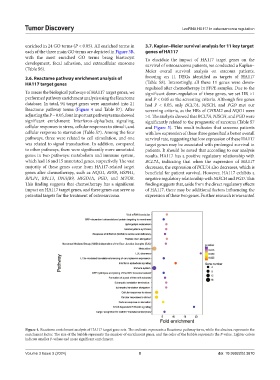
            3.6. Reactome pathway enrichment analysis of       focusing on 11 DEGs identified as targets of HA117
            HA117 target genes                                 (Table  S8).  Interestingly,  all these 11  genes  were down-
                                                               regulated after chemotherapy in FFPE samples. Due to the
            To assess the biological pathways of HA117 target genes, we   significant down-regulation of these genes, we set HR >1
            performed pathway enrichment analysis using the Reactome   and P < 0.05 as the screening criteria. Although five genes
            database. In total, 94 target genes were annotated into 21   had  P < 0.05, only  BCL7A,  NISCH, and  PGD met our
            Reactome pathway terms (Figure  4  and Table S7). After   screening criteria, as the HRs of CHRM2 and NQO1 were
            adjusting the P = 0.05, four important pathway terms showed   >1. The analysis showed that BCL7A, NISCH, and PGD were
            significant  enrichment:  Interferon-alpha/beta  signaling,   significantly related to the prognostic of sarcoma (Table S7
            cellular responses to stress, cellular responses to stimuli, and   and Figure 5). This result indicates that sarcoma patients
            cellular response to starvation (Table S7). Among the four   with low expression of these three genes had a better overall
            pathways, three were related to cell stimulation, and one   survival rate, suggesting that low expression of these HA117
            was related to signal transduction. In addition, compared   target genes may be associated with prolonged survival in
            to other pathways, there were significantly more annotated   patients. It should be noted that according to our analysis
            genes in two pathways: metabolism and immune system,   results, HA117 has a positive regulatory relationship with
            which had 16 and 15 annotated genes, respectively. The vast   BCL7A, indicating that when the expression of HA117
            majority of these genes come from HA117-related target   decreases, the expression of BCL7A also decreases, which is
            genes after chemotherapy, such as NQO1, RPS9, HSPH1,   beneficial for patient survival. However, HA117 exhibits a
            RPLP1,  RPL13,  DNAJB9,  HIGD1A,  PGD, and  MTOR.   negative regulatory relationship with NISCH and PGD. This
            This finding suggests that chemotherapy has a significant   finding suggests that, aside from the direct regulatory effects
            impact on HA117 target genes, and these genes can serve as   of HA117, there may be additional factors influencing the
            potential targets for the treatment of osteosarcoma.  expression of these two genes. Further research is warranted


            Figure 4. Reactome enrichment analysis of HA117 target gene sets. The ordinate represents a Reactome pathway term, while the abscissa represents the
            enrichment factor. The size of the bubble represents the number of enrichment genes, and the color of the bubble represents the P-value. Lighter colors
            indicate smaller P-values and more significant enrichment.


            Volume 3 Issue 3 (2024)                         8                                 doi: 10.36922/td.3670

