


Page 22 - AC-1-1
P. 22
Arts & Communication                                           Hybrid music and ethnicity in Quangang Beiguan


            include more than 30 professional theatrical troupes. These
            troupes can perform Xiang Opera, Gaojia Opera, Puxian
            Opera, Puppet Show and other local dramas, and they
            can also sing and play Beiguan. In 2010, Fujian Vocational
            College of Art opened a 5-year associate degree in Music
            Recital (major on Beiguan) in Quanzhou Art School.
              In 2014, Quangang District was honored as the
            Hometown of Beiguan Music Culture in China, and the
            Beiguan Inheritance and Protection Center was also
            established. In the same year, the People’s Government of
            Quangang District signed the Framework Agreement on
            the Inheritance, Protection, and Cooperation of Quanzhou
            Beiguan with Fujian Normal University. Therefore, the
            university began to enroll both undergraduates majoring
            in Music Recital and masters of arts whose research focus
            is Beiguan. In recent years, Quangang District has carried
            out cultural activities featuring finding common grounds,
            for example, pairing of villages with the same name in
            Fujian and Taiwan, seeking roots with villages from the
            same clan, and exchanging music pieces of the same genre.
            These events have connected eight pairs of villages with
            the same name and clan on both sides of the Taiwan Strait,
            and held many Beiguan seminars and performances to
            exchange ideas, which won popular acclaim.
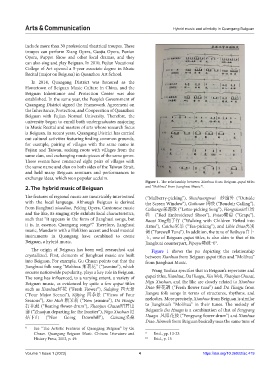
                                                               Figure 1. The relationship between Xianhua from Beiguan qupai titles
                                                                                      10
            2. The  hybrid music of Beiguan                    and “Molihua” from Jianghuai Music .
            The features of regional music are inextricably intertwined   (“Mulberry-picking”),  Shachuangwai  纱窗外 (“Outside
            with the local language. Although Beiguan is derived   the Screen Window”), Guihuan 闺唤 (“Boudoir Calling”),
            from Jianghuai xiaodiao, Peking Opera, Cantonese music   Cailiange采莲歌 (“Lotus-picking Song”), Hongxiuxie红绣
            and the like, its singing style exhibits local characteristics,   鞋  (“Red Embroidered Shoes”),  Putao葡萄  (“Grape”),
            such that “it appears in the form of Jianghuai songs, but   Baozi Xing抱子行 (“Walking with Children Hefted into
            it is, in essence, Quangang songs .” Therefore, Jianghuai   Arms”), Caicha采茶 (“Tea-picking”), and Libie Diao离别
                                       8
            music, Mandarin with a Hokkien accent and local musical   调 (“Farewell Tune”). In addition, the tune of Baibuyu白卜
            instruments in Quangang have combined to create    玉, one of Beiguan qupai titles, is also akin to that of its
            Beiguan, a hybrid music.                           Jianghuai counterpart, Pipoyu劈破玉 .
                                                                                             9 ,10
              The origin of Beiguan has been well researched and   Figure  1 shows the  pu  depicting the relationship
            crystallized. First, elements of Jianghuai music are built   between Xianhua from Beiguan qupai titles and “Molihua”
            into Beiguan. For example, Gu Chuan points out that the   from Jianghuai Music.
            Jianghuai folk song “Molihua 茉莉花” (“Jasmine”), which
            secures nationwide popularity, plays a key role in Beiguan.   Wang Yaohua specifies that in Beiguan’s repertoire and
            The song has influenced, to a varying extent, a variety of   qupai titles, Xianhua, Da Huagu, Xin Moli, Zhaojun Chusai,
            Beiguan music, as evidenced by quite a few  qupai titles   Nigu Xiashan, and the like are closely related to Xianhua
            such as  Xianhua鲜花 (“Fresh Flower”),  Sidajing  四大景   Diao  鮮花調 (“Fresh flower tune”) and  Da  Huagu from
            (“Four Major Scenes”),  Sijijing  四季景 (“Views of Four   Jiangsu folk songs in terms of structures, rhythms, and
            Seasons”), Xin Moli 新茉莉 (“New Jasmine”), Da Huagu   melodies. More precisely, Xianhua from Beiguan is similar
            打花鼓 (“Beating flower-drum”), Zhaojun Chusai昭君出     to Jianghuai’s “Molihua” in their tunes. The melody of
            塞 (“Zhaojun departing for the frontier”), Nigu Xiashan 尼  Beiguan’s Da Huagu is a combination of that of Fengyang
            姑下山     (“Nun   Going   Downhill”),  Caisang采桑     Huagu 凤阳花鼓 (“Fengyang flower drum”) and Xianhua
                                                               Diao. Xinmoli from Beiguan basically uses the same tune of
            8.    See “The Artistic Features of Quangang Beiguan” by Gu
               Chuan.  Quangang Beiguan Music. Chinese Literature and   9.    Ibid., pp. 13-23.
               History Press, 2002, p. 49.                     10.    Ibid., p. 15


            Volume 1 Issue 1 (2023)                         4                          https://doi.org/10.36922/ac.419

