


Page 25 - AC-1-1
P. 25
Arts & Communication                                           Hybrid music and ethnicity in Quangang Beiguan


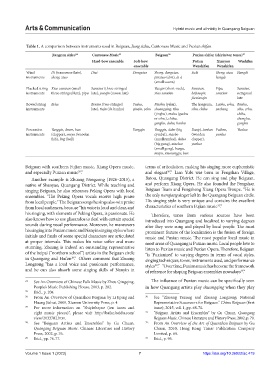
            Table 1. A comparison between instruments used in Beiguan, Jiang sizhu, Cantonese Music and Puxian shifan
                       Jiangnan sizhu 24  Cantonese Music 25       Beiguan 26      Puxian shifan (shiyin/ten tones) 27
                                        Hard‑bow ensemble  Soft‑bow                Putian    Xianyou   Wushifan
                                                          ensemble                 Wenshifan  Wenshifan
            Wind       Di (transverse flute),   Dizi     Dongxiao  Sheng, dongxiao,   Sudi   Sheng, xiao,  Hengdi
            instruments  sheng, xiao                               pinxiao (dizi), ài-á      hengdi
                                                                   (small suona)
            Plucked string  Xiao sanxian (small   Sanxian (three-stringed   Yueqin (short-neck),   Sanxian,   Pipa,   Sanxian,
            instruments  three-stringed lute), pipa lute), yueqin (moon lute)  xiao sanxian  bajiaoqin,   sanxian  octagonal
                                                                                   jiuxianqin         lute
            Bowed string   Erhu         Erxian (two-stringed   Yuehu,   Piaohu (yehu),   The haegeum,  Laohu, erhu,  Banhu,
            instruments                 lute), tiqin (da banhu)  qinqin, yehu  shuangqing, tihu   sihu, chihu  yazheng  sihu, erhu,
                                                                   (jinghu), mahu (gaohu              chihu,
                                                                   or erhu), chihu,                   zhonghu,
                                                                   ganghu, dahu, banhu                gonghu
            Percussion   Yangqin, drum, ban              Yangqin   Yangqin, dabo (big   Danpi, tanban  Paiban,   Yunluo
            instruments  (clapper), muyu (wooden                   cymbal), xiaobo   (wooden   yunluo
                       fish), ling (bell)                          (smallcymbal), daluo   clapper),
                                                                   (big gong), xiaoluo   yunluo
                                                                   (small gong), bangu,
                                                                   muyu, xiaotanggu, ban


            Beiguan with southern Fujian music, Xiang Opera music,   terms of articulation, making his singing more euphemistic
            and especially Puxian music .”                     and elegant .” Lian Yubi was born in Fengshan Village,
                                                                        30 26
                                  28 24
              Another example is Zhuang Nengzong (1926–2015), a   Batou, Quangang District. He can sing and play Beiguan,
            native of Shanyao, Quangang District. While teaching and   and perform Xiang Opera. He also founded the Fengshan
            singing Beiguan, he also rehearses Peking Opera with local   Beiguan Team and Fengsheng Xiang Opera Troupe. “He is
            ensembles.  “His  Peking  Opera  vocals  receive  high  praise   the only nanqiang singer left in the Quangang Beiguan circle.
            from local people.” The Beiguan songs he sings also win praise   His singing style is very unique and contains the excellent
                                                                                             31 27
            from local audiences, because “his voice is loud and clear, and   characteristics of southern Fujian music .”
            his singing, with elements of Peking Opera, is passionate. He   Therefore, tunes from various sources have been
            also knows how to use glissandos to deal with certain special   introduced into Quangang and localized to varying degrees
            sounds during vocal performance. Moreover, he maneuvers   after they were sung and played by local people. The most
            his singing into Puxian music and Nanyin singing styles where   prominent feature of the localization is the fusion of foreign
            initials and finals of some special characters are articulated   music and Puxian music. The most popular local music in
            at proper intervals. This makes his voice softer and more   most areas of Quangang is Puxian music. Local people love to
            stunning. Zhuang is indeed an outstanding representative   listen to Puxian music and Puxian Opera. Therefore, Beiguan
            of the beipai (“northern school”) artists in the Beiguan circle   “is ‘Puxianized’ to varying degrees in terms of vocal styles,
            in Quangang and Hui’an .” Others comment that Zhuang   singing techniques, tones, instruments used, and performance
                               29 25
            Longzong “has a loud voice and passionate performance,   styles .” “Over time, Puxian music has become the framework
                                                                   32 28
            and he can also absorb some singing skills of Nanyin in   of reference for shaping Beiguan ensembles nowadays .”
                                                                                                       33 29
            24.    See An Overview of Chinese Folk Music by Zhou Qingqing.   The influence of Puxian music can be specifically seen
               People’s Music Publishing House, 2003, p. 202.  in how Quangang artists play shuangqing when they play
            25.    Ibid., p. 204
            26.    From An Overview of Quanzhou Beiguan by Li Jiping and   30.    See “Zhuang Yuzong and Zhuang Longzong: National
               Huang Jiahui, 2009, Xiamen University Press, p. 4.  Representative Successors for Beiguan.” China Beiguan (first
            27.    For more information on “Shiyinbayue (ten tunes and   issue), 2015, vol. 1, pp. 68-70.
               eight music pieces)”, please visit  http://baike.baidu.com/  31.    “Beiguan Artists and Ensembles” by Gu Chuan.  Quangang
               view/2033702.htm.                                  Beiguan Music. Chinese Literature and History Press, 2002, p. 79.
            28.    See “Beiguan Artists and Ensembles” by Gu Chuan.   32.  From  An Overview of the Art of Quanzhou Beiguan by Gu
               Quangang Beiguan Music. Chinese Literature and History   Chuan, 2010, Hong Kong Timar Publication Company
               Press, 2002, p. 76.                                Limited, p. 69.
            29.    Ibid., pp. 76-77.                           33.    Ibid., p. 95.


            Volume 1 Issue 1 (2023)                         7                          https://doi.org/10.36922/ac.419

