


Page 23 - AC-1-1
P. 23
Arts & Communication                                           Hybrid music and ethnicity in Quangang Beiguan


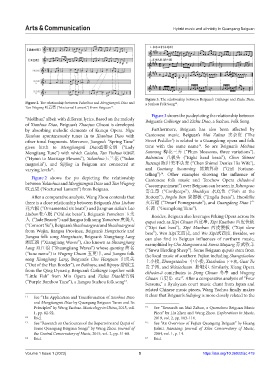
                                                               Figure 3. The relationship between Beiguan’s Cailiange and Zizhu Diao,
            Figure 2. The relationship between Yulanhua and Mengjiangnü Diao and   a Suzhou Folk Song .
                                                                           14
            Tan Wugeng 叹五更 (‘Nocturnal Lament”) from Beiguan .
                                                12
                                                                 Figure 3 shows the pu depicting the relationship between
            “Molihua,” albeit with different lyrics. Based on the melody   Beiguan’s Cailiange and Zizhu Diao, a Suzhou Folk Song.
            of Xianhua Diao, Beiguan’s Zhaojun Chusai is developed
            by absorbing melodic elements of Kunqu Opera.  Nigu   Furthermore, Beiguan has also been affected by
            Xiashan spontaneously tunes in to  Xianhua Diao with   Cantonese music. Beiguan’s  Mai Zahuo  卖杂货 (‘The
            other tonal fragments. Moreover, Jiangsu’s “Spring Tune”   Street Peddler’) is related to a Guangdong opera and folk
                                                                                     15
            gives birth to  Mengjiangnü Diao孟姜女调 (“Lady        tune  with  the  same  name .  So  are  Beiguan’s  Meihua
            Mengjiang Tune”) with which Caicha, Tan Yinhua 叹姻花   Sannong  梅花三弄 (“Plum blossoms, three variations”),
            (“Hymn to Marriage Flowers”), Yulanhua玉兰花 (“Yulan   Babantou  八板头 (“Eight head beats”),  Chen Shimei
            magnolia”), and  Sijijing in Beiguan are connected at   Burenqi 陈世美不认妻 (“Chen Shimei Denies His Wife”),
            varying levels .                                   and  Guniang Suanming  姑娘算命 (“Girl Fortune-
                       11 12
                                                               telling”) . Other examples showing the influence of
                                                                     16
              Figure 2 shows the  pu  depicting the relationship   Cantonese  folk  music  and Teochew Opera  chhoàn-á
            between Yulanhua and Mengjiangnü Diao and Tan Wugeng   (“accompaniment”) over Beiguan can be seen in Jishengcao
            叹五更 (‘Nocturnal Lament”) from Beiguan.             寄生草 (“Cordyceps”),  Shuidiyu  水底鱼 (“Fish at the
              After a comparative analysis, Wang Zhou contends that   Bottom”), Jingdu Ban 京都板 (“Jingdu Beats”), Huoshiliu
            there is a close relationship between Beiguan’s Hua Liuban   火石榴 (“Dwarf Pomegranate”), and Guangdong Diao 广
            花六板 (“Ornamented six beats”) and Jiangnan sizhu’s Lao   东调 (“Guangdong Tune”).
            Liuban老六板 (“Old six beats”), Beiguan’s Yumeiren 玉美   Besides, Beiguan also leverages Peking Opera across its
            人 (“Jade Beauty”) and Jiangsu folk song Yumeiren 虞美人   qupai such as Xipi Chuan 西皮串, Xipi Kuaiban 西皮快板
            (“Consort Yu”), Beiguan’s Shachuangwai and Shachuangwai   (“Xipi fast beat”),  Xipi Manban  西皮慢板 (“Xipi slow
            from Wujin, Jiangsu Province, Beiguan’s Hongxiuxie and   beat”), Wen Xipi文西皮, and Wu Xipi武西皮. Besides, we
            Jiangsu folk song Hongxiuxie, Beiguan’s Xiangjiang Lang   can also find in Beiguan influences of northern music,
            湘江浪 (“Xiangjiang Waves”), also known as Shuangjiang   exemplified by Chu Hanguan and Suwu Muyang 苏武牧羊
            Lang 双江浪 (“Shuangjiang Waves”) whose quming 曲名     (“Suwu Herding Sheep”). Some Beiguan qupais stem from
            (“tune name”) is Wugeng Chuan 五更串, and Jiangsu folk   the local music of southern Fujian including Shangxiaolou
            song  Xiangjiang Lang, Beiguan’s  Chu Hanguan  出汉关   上小楼, Zhongxiaolou 中小楼, Xiazhulou 下主楼, Guzi Tu
            (“Out of the Han Border”), or Baibuyu, and Bipoyu 碧破玉   贵子图, and Shixiechuan 拾鞋串. Similarly, Xiang Opera
            from the Qing Dynasty, Beiguan’s Cailiange together with   chhoàn-á contributes to  Dong Chuan  冬串 and  Wugeng
            “Little  Fish”  from  Min  Opera  and  Zizhu Diao紫竹调   Chuan 五更串 etc . After a comparative analysis of “Four
                                                                              17
            (“Purple Bamboo Tune”), a Jiangsu Suzhou folk song .  Seasons,” a Ryukyuan court music chant from Japan and
                                                      13 14
                                                               related Chinese music pieces, Wang Yaohua finally makes
            11.    See “The Application and Transformation of Xianhua Diao   it clear that Beiguan’s Sidajing is more closely related to the
               and Mengjiangnü Diao by Quangang Beiguan Tunes and Its
               Principles” by Wang Yaohua. Musicology in China, 2015, vol.   15.    See “Research on Mai Zahuo, a Quanzhou Beiguan Music
               1, pp. 82-92.                                      Piece” by Liu Zhen and Wang Zhou. Explorations in Music,
            12.  Ibid.                                            2019, vol. 2, pp. 103-114.
            13.    See “Research on the Sources of the Repertoire and Qupai of   16.    See “An Overview of Fujian Quangang Beiguan” by Huang
               Some Quangang Beiguan Songs” by Wang Zhou. Journal of   Jiahui.  Jiaoxiang: Journal of Xi’an Conservatory of Music,
               the Central Conservatory of Music, 2015, vol. 2, pp. 51-68.  2004, vol. 1, p. 14.
            14.  Ibid.                                         17.  Ibid.


            Volume 1 Issue 1 (2023)                         5                          https://doi.org/10.36922/ac.419

