


Page 23 - AIH-2-1
P. 23
Artificial Intelligence in Health                          COVID-19 diagnosis: FPA, k-NN, and SVM classifiers


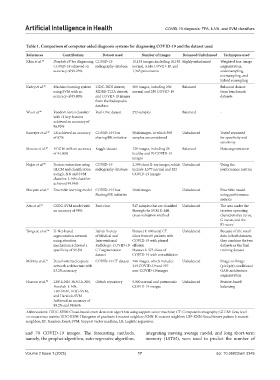
            Table 1. Comparison of computer‑aided diagnosis systems for diagnosing COVID‑19 and the dataset used
            References      Contribution     Dataset used    Number of images  Balanced/Unbalanced  Techniques used
            Khin et al. 39  Deeplab v3 for diagnosing  COVID-19   15,153 images, including 10,192  Highly unbalanced  Weighted loss, image
                               +
                        COVID-19 achieved an   radiography database  normal, 3,616 COVID-19, and   augmentation,
                        accuracy of 99.23%               1,345 pneumonia                       undersampling,
                                                                                               oversampling, and
                                                                                               hybrid resampling
            Kadry et al. 45  Machine learning system  LIDC-IRDI dataset,   500 images, including 250   Balanced  Balanced dataset
                        using SVM with an   RIDER-TCIA dataset,  normal and 250 COVID-19       from benchmark
                        accuracy of 89.80%  and COVID-19 images                                datasets
                                          from the Radiopedia
                                          database
            Wu et al. 46  Random forest classifier   Real-time dataset  253 samples  Balanced  -
                        with 11 key features
                        achieved an accuracy of
                        96.95%
            Banerjee et al. 47  LR achieved an accuracy   COVID-19 Data   5644 images, in which 598   Unbalanced  Tested separated
                        of 87%            sharing/BR initiative  samples are considered        for specificity and
                                                                                               sensitivity
            Moutaz et al. 48  VGG16 with an accuracy  Kaggle dataset  128 images, including 28   Balanced  Data augmentation
                        of 94.80%                        healthy and 70 COVID-19
                                                         images
            Najjar et al. 50  Feature extraction using   COVID-19   2,399 chest X-ray images, which  Unbalanced  Using the
                        GLCM and classification   radiography database  include 1,577 normal and 822   performance metrics
                        using k-NN and SVM               COVID-19 images
                        classifier. k-NN classifier
                        achieved 99.96%
            Maryam et al. 51  Ensemble learning model COVID-19 Data   5644 images  Unbalanced  Ensemble model
                                          Sharing/BR initiative                                using performance
                                                                                               metrics
            Atta et al. 52  CSDC-SVM model with   Real-time  547 samples that are classified   Unbalanced  The area under the
                        an accuracy of 98%               through the SVM K-fold                receiver operating
                                                         cross-validation method               characteristics curve,
                                                                                               G-mean, and the
                                                                                               F1-score
            Tongxue et al. 54  U-Net-based   Italian Society   Dataset 1: 100 axial CT   Unbalanced  Because of the small
                        segmentation network   of Medical and   slices from 60 patients with   data in both datasets,
                        using attention   Interventional   COVID-19 with pleural               they combine the two
                        mechanism achieved a   Radiology: COVID-19  effusion                   datasets as the final
                        specificity of 99.3%  CT segmentation   Dataset 2: 373 slices of       training dataset
                                          dataset        COVID-19 with consolidation
            Mobiny et al. 55  Detail-oriented capsule   COVID-19 CT dataset 746 images, which includes   Unbalanced  Image-to-Image
                        network architecture with        349 COVID-19 and 397                  (pi×2pix) conditional
                        83.2% accuracy                   non-COVID-19 images                   GAN architecture
                                                                                               augmentation
            Hasoon et al. 56  LBP-k-NN, HOG-k-NN,  Github repository  5,000 normal and pneumonia   Unbalanced  Feature-based
                        Haralick-k-NN,                   COVID-19 images                       balancing
                        LBP-SVM, HOG-SVM,
                        and Haralick-SVM.
                        Achieved an accuracy of
                        89.2% and 98.66%
            Abbreviations: CSDC-SVM: Cloud-based smart detection algorithm using support vector machine; CT: Computed tomography; GLCM: Gray level
            co-occurrence matrix; HOG-KNN: Histogram of gradients k nearest neighbor; KNN: K-nearest neighbor; LBP-KNN: Local binary pattern k nearest
            neighbor; RF: Random forest; SVM: Support vector machine; LR: Logistic regression.

            and 70 COVID-19 images. The forecasting methods,   integrating moving average model, and long short-term
            namely, the prophet algorithm, auto-regressive algorithm,   memory (LSTM), were used to predict the number of


            Volume 2 Issue 1 (2025)                         17                               doi: 10.36922/aih.3349

