


Page 28 - AIH-2-1
P. 28
Artificial Intelligence in Health                          COVID-19 diagnosis: FPA, k-NN, and SVM classifiers


            Table 4. Overview of the experimental dataset
            Patient cases  Total no. of patients  Total COVID‑19 CT slices considered  ROIs  Training set ROIs  Testing set ROIs
            COVID-19            26                     342                343         242             101
            Normal              15                     446                452         394             58
            Total               41                     788                795         636             159
            Abbreviations: CT: Computed tomography; ROI: Region of interest.

              For the COVID-19 CT database, a publicly available   A                 B
            dataset was utilized to train and test the proposed model.
            It contains a total of 349 COVID-19 CT images from
            216  patients and 463 non-COVID-19 CTs, which have
            been  divided  into  two  classes,  namely,  COVID-19  and
            non-COVID-19. The COVID-19 CT dataset was divided
            into  training  and  testing  datasets,  with  training  datasets
            comprising 80% of the total and testing datasets 20%.   C                 D
            A  pre-processed version  of  the  dataset  is  available  at
            https://github.com/UCSD-AI4H/COVID-CT.

            4.2. Performance evaluation
            The aim of this work is to decrease the false negative and
            false positive values, that is, to increase the sensitivity and
            specificity, respectively. However, there is often a tradeoff
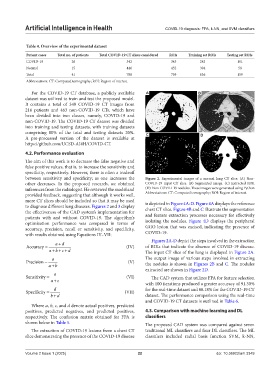
            between sensitivity and specificity; as one increases the   Figure  2.  Experimental  images  of  a  normal  lung  CT  slice.  (A)  Non-
            other decreases. In the proposed research, we obtained   COVID-19 input CT slice. (B) Segmented image. (C) Extracted ROI.
            inferences from the radiologist. He reviewed the model and   (D)  Non-COVID-19 nodules. These images were generated using Python
            provided feedback, suggesting that although it works well,   Abbreviations: CT: Computed tomography; ROI: Region of interest.
            more CT slices should be included so that it may be used   is depicted in Figure 4A‑D. Figure 4A displays the reference
            to diagnose different lung diseases. Figures 2 and 3 display   chest CT slice. Figure 4B and C illustrate the segmentation
            the effectiveness of the CAD system’s implementation for   and feature extraction processes necessary for effectively
            patients with and without COVID-19. The algorithm’s
            optimization performance was compared in terms of   isolating the nodules.  Figure  4D displays the peripheral
            accuracy, precision, recall or sensitivity, and specificity,   GGO lesion that was excised, indicating the presence of
            with results obtained using Equations IV–VII:      COVID-19.
                                                                 Figures 2A‑D depict the steps involved in the extraction
                         ad

            Accuracy                                  (IV)    of ROIs that indicate the absence of COVID-19 disease.
                        cd
                      ab                                       The input CT slice of the lung is displayed in Figure 2A.
                       a                                       The output image of various steps involved in extracting
            Precision                                 (V)     the nodules is shown in Figures 2B and C. The nodules

                      ab
                                                               extracted are shown in Figure 2D.
                        a
            Sensitivity                               (VI)      The CAD system that utilizes FPA for feature selection

                       ac
                                                               with 100 iterations produced a greater accuracy of 91.30%
                        d                                      for the real-time dataset and 88.18% for the COVID-19 CT
            Specificity                              (VII)

                       bd                                      dataset. The performance comparison using the real-time
                                                               and COVID-19 CT datasets is outlined in Table 6.
              Where a, b, c, and d denote actual positives, predicted
            positives,  predicted  negatives,  and  predicted  positives,   4.3. Comparison with machine learning and DL
            respectively.  The  confusion  matrix  obtained  for  FPA  is   classifiers
            shown below in Table 5.                            The proposed CAD system was compared against seven
              The extraction of COVID-19 lesions from a chest CT   traditional ML classifiers and four DL classifiers. The ML
            slice demonstrating the presence of the COVID-19 disease   classifiers included radial basis function SVM, k-NN,


            Volume 2 Issue 1 (2025)                         22                               doi: 10.36922/aih.3349

