


Page 30 - AIH-2-1
P. 30
Artificial Intelligence in Health                          COVID-19 diagnosis: FPA, k-NN, and SVM classifiers


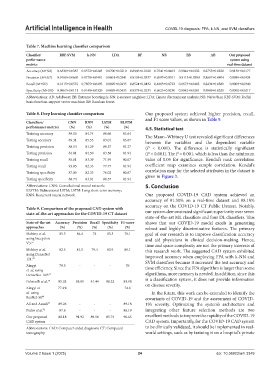
            Table 7. Machine learning classifier comparison
            Classifier/   RBF‑SVM     k‑NN       LDA        RF        NB        EB         AB     Our proposed
            performance                                                                            system using
            metrics                                                                               real‑time dataset
            Accuracy (M±SD)  0.6329±0.0387 0.8572±0.0243 0.8706±0.0210 0.8996±0.0180 0.7541±0.0403 0.9044±0.0232 0.8753±0.0220  0.9130±0.0177
            Precision (M±SD)  0.9189±0.0660 0.8779±0.0481 0.8861±0.0341 0.9135±0.0337 0.9093±0.0551  0.9113±0.0388 0.8697±0.0404  0.8989±0.0324
            Recall (M±SD)  0.1815±0.0515 0.7855±0.0495 0.8095±0.0435 0.8524±0.0432 0.4883±0.0722 0.8673±0.0403 0.8434±0.0381  0.8003±0.0340
            Specificity (M±SD)  0.9867±0.0111 0.9149±0.0320 0.8095±0.0435 0.9373±0.0235 0.9625±0.0230 0.9342±0.0281 0.9009±0.0321  0.9302±0.0217
            Abbreviations: AB: AdaBoost; EB: Extreme boosting; k-NN: k-nearest neighbor; LDA: Linear discriminant analysis; NB: Naïve bias; RBF-SVM: Radial
            basis function-support vector machine; RF: Random forest.

            Table 8. Deep learning classifier comparison       Our proposed system achieved higher precision, recall,
                                                               and F1 score values, as shown in Table 9.
            Classifiers/      CNN    RNN    LSTM    BLSTM
            performance metrics  (%)  (%)    (%)      (%)      4.5. Statistical test
            Training accuracy  89.15  84.74  80.66   83.64     The Mann–Whitney U test revealed significant differences
            Testing accuracy  89.31  85.53   83.01   83.67     between the variables and the dependent variable
            Training precision  88.54  81.29  80.57  81.27     (P < 0.001). The difference is statistically significant
            Testing precision  84.81  84.50  83.58   81.94     (P < 0.001). The P = 0.001, which is less than the minimum
            Training recall   85.61  83.39   71.95   80.07     value of 0.05 for significance. Kendal’s rank correlation
            Testing recall    93.05  82.33   77.77   81.94     coefficient map examines sample correlation. Kendal’s
            Training specificity  87.05  82.33  76.02  80.67   correlation map for the selected attributes in the dataset is
            Testing specificity  88.74  83.91  80.57  81.94    given in Figure 3.
            Abbreviations: CNN: Convolutional neural network;   5. Conclusion
            BLSTM: Bidirectional LSTM; LSTM: Long short-term memory;
            RNN: Recurrent neural network.                     Our proposed COVID-19 CAD system achieved an
                                                               accuracy of 91.30% on a real-time dataset and 88.18%
                                                               accuracy on the COVID-19 CT Public Dataset. Notably,
            Table 9. Comparison of the proposed CAD system with
            state‑of‑the‑art approaches for the COVID‑19 CT dataset  our system demonstrated significant superiority over seven
                                                               state-of-the-art ML classifiers and four DL classifiers. This
            State‑of‑the‑art   Accuracy  Precision  Recall  Specificity  F1‑score   shows that our COVID-19 model excels in generating
            approaches    (%)     (%)   (%)    (%)    (%)      robust and highly discriminative features. The primary
            Mobiny et al.   85.3  84.4   74    85.3   78.1     goal of our research is to improve classification accuracy
            using Inception                                    and aid physicians in clinical decision-making. Hence,
            V3. 55                                             time and space complexity are not the primary interests of
            Mobiny et al.   82.5  81.5  79.4   83.9   80.1     this research work. The suggested CAD system exhibited
            using DenseNet                                     improved accuracy when employing FPA with k-NN and
            121. 55                                            SVM classifiers because it increased the test accuracy and
            Xingyi        79.5     -     -      -      76      time efficiency. Since the FPA algorithm is larger than some
            et  al. using
            DenseNet-169. 69                                   algorithms, more memory is needed. In addition, since this
            Polsinelli et al. 70  85.03  85.01  81.44  88.23  83.98  is a classification system, it does not provide information
            Xingyi et     77.4%    -     -      -     74.6     on disease severity.
            al. using                                            In the future, this work can be extended to identify the
            ResNet-50 69                                       covariants of COVID-19 and the assessment of COVID-
            Ali and Assadi 71  89.26  -  -      -     89.18    19’s severity. Optimizing the system’s architecture and
            Pedro et al. 72  87.6  -     -      -     86.19    integrating other feature selection methods are two
            Our proposed   88.18  91.92  89.56  85.74  90.65   excellent methods to improve the rapidity of the COVID-19
            CAD system                                         CAD system. Importantly, for the COVID-19 CAD system
            Abbreviations: CAD: Computer-aided diagnosis; CT: Computed   to be clinically validated, it should be implemented in real-
            tomography.                                        world settings, such as by training it on a hospital’s private


            Volume 2 Issue 1 (2025)                         24                               doi: 10.36922/aih.3349

