


Page 25 - AIH-2-1
P. 25
Artificial Intelligence in Health                          COVID-19 diagnosis: FPA, k-NN, and SVM classifiers


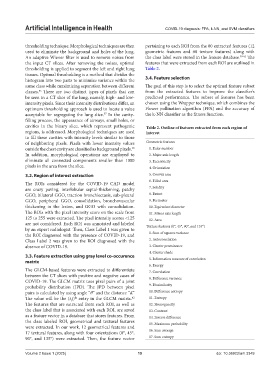
            thresholding technique. Morphological techniques are then   pertaining to each ROI from the 80 extracted features (12
            used to eliminate the background and holes of the lung.   geometric features and 68 texture features) along with
            An adaptive Wiener filter is used to remove noises from   the class label were stored in the feature database. 59-61  The
            the input CT slices. After removing the noises, optimal   features that were extracted from each ROI are outlined in
            thresholding is applied to segment the left and right lung   Table 2.
            tissues. Optimal thresholding is a method that divides the
            histogram into two parts to minimize variance within the   3.4. Feature selection
            same class while maximizing separation between different   The goal of this step is to select the optimal feature subset
            classes.  There are two distinct types of pixels that can   from the extracted features to improve the classifier’s
                  53
            be seen in a CT slice of the lung, namely, high- and low-  predicted performance. The subset of features has been
            intensity pixels. Since their intensity distributions differ, an   chosen using the Wrapper technique, which combines the
            optimum thresholding approach is used to locate a value   Flower pollination algorithm (FPA) and the accuracy of
            acceptable for segregating the lung slice.  In the cavity-  the k-NN classifier as the fitness function.
                                             57
            filling process, the appearance of airways, small holes, or
            cavities in the binary slice, which represent pathogenic   Table 2. Outline of features extracted from each region of
            regions, is addressed. Morphological techniques are used   interest
            to fill these cavities with intensity levels similar to those
            of  neighboring  pixels.  Pixels  with  lower  intensity  values   Geometric features
            outside the chest cavity are classified as background pixels.    1. Euler number
                                                         58
            In addition, morphological operations are employed to   2. Major axis length
            eliminate all connected components smaller than 1000   3. Eccentricity
            pixels in the area from the slice.                  4. Orientation

            3.2. Region of interest extraction                  5. Convex area
                                                                6. Filled area
            The ROIs considered for the COVID-19 CAD model
            are crazy paving, interlobular septal-thickening, patchy   7. Solidity
            GGO, bilateral GGO, traction bronchiectasis, sub-pleural   8. Extent
            GGO, peripheral GGO, consolidation, bronchovascular   9. Perimeter
            thickening in the lesion, and GGO with consolidation.   10. Equivalent diameter
            The ROIs with the pixel intensity score on the scale from   11. Minor axis length
            125 to 255 were extracted. The pixel intensity scores <125   12. Area
            are not considered. Each ROI was annotated and labeled   Texture features (0°, 45°, 90°, and 135°)
            by an expert radiologist. Then, Class Label 1 was given to
            the ROI diagnosed with the presence of COVID-19, and   1. Sum of squares variance
            Class  Label 2 was given to the ROI diagnosed with the   2. Autocorrelation
            absence of COVID-19.                                3. Cluster prominence
                                                                4. Cluster shade
            3.3. Feature extraction using gray level co-occurence   5. Information measure of correlation
            matrix
                                                                6. Energy
            The GLCM-based features were extracted to differentiate   7. Correlation
            between the CT slices with positive and negative cases of   8. Difference variance
            COVID-19. The GLCM matrix uses pixel pairs of a joint
            probability distribution (JPD). The JPD between pixel   9. Dissimilarity
            pairs is calculated by using angle “θ” and the distance “d.”   10. Difference entropy
            The value will be the (i,j)  entry in the GLCM matrix.    11. Entropy
                                 th
                                                         42
            The features that are extracted from each ROI, as well as   12. Homogeneity
            the class label that is associated with each ROI, are saved   13. Contrast
            as a feature vector in a database that stores features. From   14. Inverse difference
            the class labeled ROI, geometrical and textural features   15. Maximum probability
            were extracted. In our work, 12 geometrical features and
            17 textural features, along with four orientations (0°, 45°,   16. Sum average
            90°, and 135°) were extracted. Then, the feature vector   17. Sum entropy


            Volume 2 Issue 1 (2025)                         19                               doi: 10.36922/aih.3349

