


Page 24 - AIH-2-1
P. 24
Artificial Intelligence in Health                          COVID-19 diagnosis: FPA, k-NN, and SVM classifiers


            COVID-19 confirmations. The proposed system achieved   features promotes classification performance. Third, a
            an accuracy of 94.80%.                             wrapper-based feature selection strategy that uses bio-
              Feng  et al.   have  proposed  a  predictive  model  using   inspired algorithms is more robust and performs better
                       49
            four classifiers, namely LR with LASSO, LR with ridge   in a variety of optimization challenges when compared to
            regularization, decision tree, and adaptive boosting (AB)   conventional approaches to feature selection.
            algorithms, for the early detection of COVID-19 disease.   3. Methods
            The strength of this proposed model lies in the 46-feature
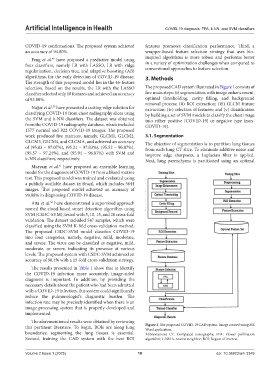
            selection. Based on the results, the LR with the  LASSO   The proposed CAD system illustrated in Figure 1 consists of
            classifier selected only 18 features and achieved an accuracy   five main steps: (i) segmentation with image enhancement,
            of 93.80%.                                         optimal thresholding, cavity filling, and background
                                                               removal process; (ii) ROI extraction; (iii) GLCM feature
              Najjar et al.  have presented a cutting-edge solution for   extraction; (iv) selection of features; and (v) classification
                       50
            classifying COVID-19 from chest radiography slices using   by building a set of SVM models to classify the chest image
            the SVM and k-NN classifiers. The dataset was obtained   into either positive (COVID-19) or negative type (non-
            from the COVID-19 radiography database, which included   COVID-19).
            1577 normal and 822 COVID-19 images. The proposed
            work produced five matrices, namely, GLCM1, GLCM2,   3.1. Segmentation
            GLCM3, GLCM4, and GLCMA, and achieved an accuracy   The objective of segmentation is to partition lung tissues
            of (95.83 – 97.07%), (95.21 – 97.03%), (95.52 – 96.87%),   from each lung CT slice. To eliminate additive noise and
            (95.57 –  97.24%), and (95.94  – 96.87%)  with SVM  and   improve edge sharpness, a Laplacian filter is applied.
            k-NN classifiers, respectively.                    Next, lung parenchyma is partitioned using an optimal

                          51
              Maryam  et al.   have  proposed  an  ensemble  learning
            model for the diagnosis of COVID-19 from a blood routine
            test. This proposed model was trained and evaluated using
            a publicly available dataset in Brazil, which includes 5644
            images. This proposed model achieved an accuracy of
            99.88% in diagnosing COVID-19 disease.
              Atta et al.  have demonstrated a supervised approach
                      52
            named the cloud-based smart detection algorithm using
            SVM (CSDC-SVM), tested with 5, 10, 15, and 20 cross-fold
            validation. The dataset included 547 samples, which were
            classified using the SVM K-fold cross-validation method.
            The proposed CSDC-SVM model classifies COVID-19
            into four categories, namely, negative, mild, moderate,
            and severe. The virus can be classified as negative, mild,
            moderate, or severe, indicating its presence  at various
            levels. The proposed system with CSDC-SVM achieved an
            accuracy of 98.4% with a 15-fold cross-validation strategy.
              The results presented in Table 1 show that to identify
            the COVID-19 infection more accurately, image-aided
            diagnosis is important. In addition, by providing the
            necessary details about the patient who had been admitted
            with a COVID-19 infection, this system could significantly
            reduce the pulmonologist’s diagnostic burden. The
            infection rate may be precisely identified when there is an
            image processing system that is properly developed and
            implemented.

              The aforementioned results were obtained by reviewing
            this  pertinent literature.  To begin,  ROIs are  along  lung   Figure 1. The proposed COVID-19 CAD system. Image created using MS
                                                               Word application.
            boundaries; segmenting the lung tissues is essential.   Abbreviations: CT: Computed tomography; FPA: Flower pollination
            Second, training the CAD system with the best ROI   algorithm; k-NN: k-nearest neighbor; ROI: Region of interest.


            Volume 2 Issue 1 (2025)                         18                               doi: 10.36922/aih.3349

