


Page 106 - AIH-2-3
P. 106
Artificial Intelligence in Health                                  Bone suppression utility for chest diagnosis


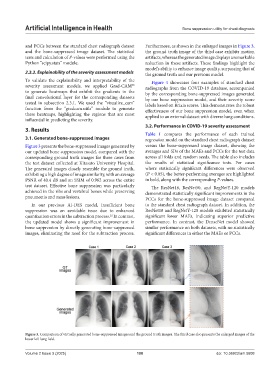
            and PCCs between the standard chest radiograph dataset   Furthermore, as shown in the enlarged images in Figure 3,
            and the bone-suppressed image dataset. The statistical   the ground truth image of the third case exhibits motion
            tests and calculation of P-values were performed using the   artifacts, whereas the generated image displays a remarkable
            Python “scipy.stats” module.                       reduction in these artifacts. These findings highlight the
                                                               model’s ability to enhance image quality, surpassing that of
            2.3.2. Explainability of the severity assessment models  the ground truth and our previous model.
            To validate the explainability and interpretability of the   Figure  4 showcases four examples of standard chest
            severity assessment models, we applied Grad-CAM    radiographs from the COVID-19 database, accompanied
                                                         38
            to generate heatmaps that exhibit the gradients in the   by the corresponding bone-suppressed images generated
            final convolutional layer for the corresponding datasets   by our bone suppression model, and their severity score
            tested  in  subsection  2.3.1.  We  used  the  “visualize_cam”   labels based on Brixia scores. This demonstrates the robust
            function from the “gradcam.utils” module to generate   effectiveness of our bone suppression model, even when
            these  heatmaps,  highlighting  the  regions  that  are  most   applied to an external dataset with diverse lung conditions.
            influential in predicting the severity.
                                                               3.2. Performance in COVID-19 severity assessment
            3. Results
                                                               Table 1 compares the performance of each trained
            3.1. Generated bone-suppressed images              regression model on the standard chest radiograph dataset
            Figure 3 presents the bone-suppressed images generated by   versus  the bone-suppressed image  dataset,  showing  the
            our updated bone suppression model, compared with the   averages and SDs of the MAEs and PCCs for the test data
            corresponding ground truth images for three cases from   across all folds and random seeds. The table also includes
            the test dataset collected at Kitasato University Hospital.   the results of statistical significance tests. For cases
            The generated images closely resemble the ground truth,   where  statistically  significant  differences  were  observed
            exhibiting a high degree of image similarity, with an average   (P < 0.05), the better-performing averages are highlighted
            PSNR of 40.4 dB and an SSIM of 0.962 across the entire   in bold, along with the corresponding P-values.
            test  dataset.  Effective  bone suppression was  particularly   The ResNet18, ResNet50, and RegNetY-120 models
            achieved in the ribs and vertebral bones while preserving   demonstrated statistically significant improvements in the
            pneumonia and mass lesions.                        PCCs for the bone-suppressed image dataset compared
              In our previous AI-DES model, insufficient bone   to the standard chest radiograph dataset. In addition, the
            suppression was an avoidable issue due to enhanced   ResNet18 and RegNetY-120 models exhibited statistically
            quantization errors in the subtraction process.  In contrast,   significant lower MAEs, indicating superior predictive
                                                22
            the updated model shows a significant improvement in   performance. In contrast, the DenseNet model showed
            bone suppression by directly generating bone-suppressed   similar performance on both datasets, with no statistically
            images, eliminating the need for the subtraction process.   significant differences in either the MAEs or PCCs.


            Figure 3. Comparison of virtually generated bone-suppressed images and the ground truth images. The third case also presents the enlarged images of the
            lower left lung field.


            Volume 2 Issue 3 (2025)                        100                               doi: 10.36922/aih.5608

