


Page 108 - AIH-2-3
P. 108
Artificial Intelligence in Health                                  Bone suppression utility for chest diagnosis


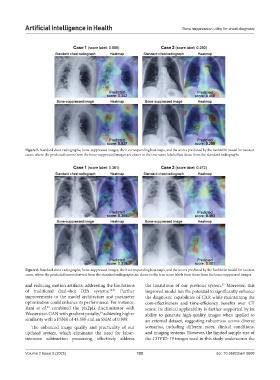
            Figure 5. Standard chest radiographs, bone-suppressed images, their corresponding heatmaps, and the scores predicted by the ResNet50 model for two test
            cases, where the predicted scores from the bone-suppressed images are closer to the true score labels than those from the standard radiographs.


            Figure 6. Standard chest radiographs, bone-suppressed images, their corresponding heatmaps, and the scores predicted by the ResNet50 model for two test
            cases, where the predicted scores derived from the standard radiographs are closer to the true score labels than those from the bone-suppressed images.

            and reducing motion artifacts, addressing the limitations   the limitations of our previous system.  Moreover, this
                                                                                               22
            of traditional dual-shot DES systems. 52,53  Further   improved model has the potential to significantly enhance
            improvements to the model architecture and parameter   the diagnostic capabilities of CXR while maintaining the
            optimization could enhance its performance. For instance,   cost-effectiveness  and  time-efficiency  benefits  over  CT
            Rani  et al.  combined the pix2pix discriminator with   scans. Its clinical applicability is further supported by its
                     23
            Wasserstein GAN with gradient penalty,  achieving higher   ability  to  generate  high-quality  images  when  applied  to
                                            54
            similarity with a PSNR of 43.588 and an SSIM of 0.989.  an external dataset, suggesting robustness across diverse
              The enhanced image quality and practicality of our   scenarios, including different races, clinical conditions,
            updated system, which eliminates the need for labor-  and imaging systems. However, the limited sample size of
            intensive subtraction  processing,  effectively  address   the COVID-19 images used in this study underscores the


            Volume 2 Issue 3 (2025)                        102                               doi: 10.36922/aih.5608

