


Page 107 - AIH-2-3
P. 107
Artificial Intelligence in Health                                  Bone suppression utility for chest diagnosis


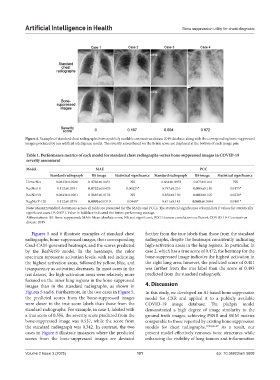
            Figure 4. Examples of standard chest radiographs from a publicly available coronavirus disease 2019 database, along with the corresponding bone-suppressed
            images produced by our artificial intelligence model. The severity scores based on the Brixia score are displayed at the bottom of each image pair.

            Table 1. Performance metrics of each model for standard chest radiographs versus bone‑suppressed images in COVID‑19
            severity assessment
            Model                         MAE                                         PCC
                      Standard radiograph  BS image  Statistical significance  Standard radiograph  BS image  Statistical significance
            DenseNet     0.0823±0.0286  0.0768±0.0451    NS           0.864±0.0953  0.873±0.164     NS
            ResNet18     0.112±0.0551  0.0722±0.0435   0.00225*       0.797±0.216  0.895±0.150     0.0175*
            ResNet50     0.0843±0.0261  0.0685±0.0178    NS           0.858±0.130  0.882±0.105     0.0230*
            RegNetY-120  0.112±0.0379  0.0993±0.0319   0.0448*        0.811±0.143  0.868±0.0984    0.0181*
            Note: Means±standard deviations across all folds are presented for the MAEs and PCCs. The statistical significance column lists P values for statistically
            significant cases (P<0.05*). Value in boldface indicated the better-performing average.
            Abbreviations: BS: Bone-suppressed; MAE: Mean absolute error; NS: not significant; PCC: Pearson correlation coefficient, COVID-19: Coronavirus
            disease 2019.

              Figures  5 and 6 illustrate examples  of standard chest   further from the true labels than those from the standard
            radiographs, bone-suppressed images, their corresponding   radiographs, despite the heatmaps consistently indicating
            Grad-CAM-generated heatmaps, and the scores predicted   high-activation areas in the lung regions. In particular, in
            by the ResNet50 model. In the heatmaps, the color   case 2, which has a true score of 0.472, the heatmap for the
            spectrum represents activation levels, with red indicating   bone-suppressed image indicates the highest activation in
            the highest activation areas, followed by yellow, blue, and   the right lung area; however, the predicted score of 0.401
            transparency as activation decreases. In most cases in the   was further from the true label than the score of 0.493
            test dataset, the high-activation areas were relatively more   predicted from the standard radiograph.
            focused on the inner lung regions in the bone-suppressed
            images than in the standard radiographs, as shown in   4. Discussion
            Figures 5 and 6. Furthermore, in the two cases in Figure 5,   In this study, we developed an AI-based bone suppression
            the  predicted  scores  from the  bone-suppressed images   model  for CXR and  applied it to  a publicly available
            were closer to the true score labels than those from the   COVID-19 image database. The pix2pix model
            standard radiographs. For example, in case 1, labeled with   demonstrated a high degree of image similarity to the
            a true score of 0.556, the severity score predicted from the   ground truth images, achieving PSNR and SSIM metrics
            bone-suppressed image was 0.537, while the score from   comparable to those reported by existing bone suppression
            the standard radiograph was 0.342. In contrast, the two   models for chest radiographs. 17,23,26-27  As a result, our
            cases in Figure 6 illustrate instances where the predicted   present model effectively removes bone structures while
            scores from the bone-suppressed images are deviated   enhancing the visibility of lung tumors and inflammation


            Volume 2 Issue 3 (2025)                        101                               doi: 10.36922/aih.5608

