


Page 75 - AIH-2-3
P. 75
Artificial Intelligence in Health                                        CNN model for leukemia diagnosis


                                                               connections between different abnormalities, such as the
                                                               size of blasts and their irregular chromatin patterns, which
                                                               are used to differentiate between subtypes of leukemia,
                                                               such as ALL or CML. This layer ensures the model can
                                                               generalize well across different patient data.

                                                                 The  Activation Function introduces non-linearity,
                                                               allowing the network to handle the complex patterns that
                                                               distinguish leukemia from other conditions or healthy
                                                               samples. For instance, functions such as ReLU or sigmoid
                                                               enable the model to prioritize significant features and
                                                               ignore irrelevant noise.
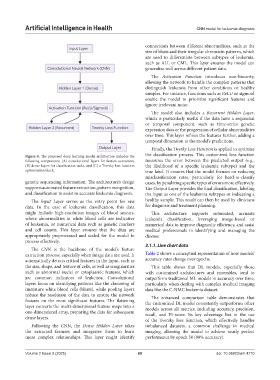
                                                                 The model also includes a  Recurrent  Hidden  Layer,
                                                               which is particularly useful if the data have a sequential
                                                               or temporal  component,  such as  time-series genetic
                                                               expression data or the progression of cellular abnormalities
                                                               over time. This layer refines the features further, adding a
                                                               temporal dimension to the model’s predictions.
                                                                 Finally, the Twerky Loss Function is applied to optimize
            Figure 4. The proposed deep learning model architecture includes the   the classification process. This customized loss function
            following components: (A) convolutional layers for feature extraction,   measures the error between the predicted output (e.g.,
            (B) dense layers for classification tasks, and (C) a Tversky loss function   the  likelihood of  a specific  leukemia subtype) and  the
            optimization block.                                true label. It ensures that the model focuses on reducing
                                                               misclassification rates, particularly for hard-to-classify
            genetic sequencing information. The architecture’s design   cases, by penalizing specific types of errors more effectively.
            supports automated feature extraction, pattern recognition,   The Output Layer provides the final classification, labeling
            and classification to assist in accurate leukemia diagnosis.  the input as one of the leukemia subtypes or indicating a

              The  Input Layer serves as the entry point for raw   healthy sample. This result can then be used by clinicians
            data. In the case of leukemia classification, this data   for diagnosis and treatment planning.
            might include  high-resolution  images of  blood  smears,   This architecture supports automated, accurate
            where abnormalities in white blood cells are indicative   leukemia classification, leveraging image-based or
            of  leukemia, or  numerical  data such as  genetic  markers   numerical data to improve diagnostic efficiency, and assist
            and cell counts. This layer ensures that the data are   medical professionals in identifying and managing the
            appropriately preprocessed and scaled for the model to   disease.
            process effectively.
                                                               3.1.1. Line chart data
              The  CNN is the backbone of the model’s feature
            extraction process, especially when image data are used. It   Table 2 shows a conceptual representation of how models’
            automatically detects critical features in the input, such as   accuracy rates change over epochs.
            the size, shape, and texture of cells, as well as irregularities   This  table shows that DL models, especially those
            such as abnormal nuclei or cytoplasmic features, which   with  customized  architectures and  ensembles,  tend  to
            are common indicators of leukemia. Convolutional   outperform traditional ML models in accuracy over time,
            layers focus on identifying patterns like the clustering of   particularly when dealing with complex medical imaging
            immature white blood cells (blasts), while pooling layers   data like the C-NMC leukemia dataset.
            reduce the resolution of the data to ensure the network   The  enhanced  comparison  table  demonstrates  that
            focuses on the most significant features. The flattening   the customized DL model consistently outperforms other
            layer converts the multi-dimensional feature maps into a   models across all metrics, including accuracy, precision,
            one-dimensional array, preparing the data for subsequent   recall,  and  F1-score.  Its  key  advantage  lies  in  the  use
            dense layers.
                                                               of the Tversky loss function, which effectively handles
              Following the CNN, the  Dense  Hidden  Layer takes   imbalanced datasets, a common challenge in medical
            the extracted features and integrates them to learn   imaging, allowing the model to achieve nearly perfect
            more complex relationships. This layer might identify   performance by epoch 50 (99% accuracy).


            Volume 2 Issue 3 (2025)                         69                               doi: 10.36922/aih.4710

