


Page 77 - AIH-2-3
P. 77
Artificial Intelligence in Health                                        CNN model for leukemia diagnosis


            Table 2. (Continued)
            Epochs       Model       Accuracy   Precision   Recall   F1‑Score   Method for handling   Key contributions
                                       (%)       (%)     (%)      (%)     imbalanced data
            50      SVM + CNN Hybrid    82       80       81      80.5   No explicit method  Final performance stabilizes,
                                                                                          good but not competitive
                                                                                          with DL models
            50      Traditional ML      72       70       72      71     No explicit method  Best possible performance
                                                                                          but still behind DL
                                                                                          approaches
            Abbreviations: CNN: Convolutional neural network; DL: Deep learning; ML: Machine learning; SVM: Support vector machine.

              In contrast, models such as ResNet101 Ensemble and
            ALLNET show strong performance but do not explicitly
            address data imbalance issues, leading to slightly lower
            overall accuracy and precision. While these models are
            competitive, they fall short in scenarios where balanced
            classification is crucial.
              Support vector machine + CNN Hybrid and traditional
            ML models perform relatively well in earlier epochs but
            are ultimately limited by their inability to handle complex
            imbalanced datasets and achieve lower performance
            metrics compared to the DL approaches.

            3.2. Training process
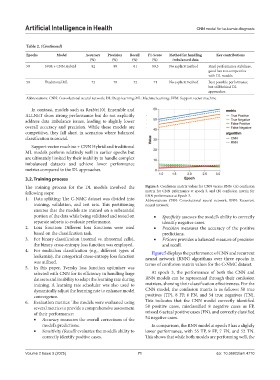
            The  training  process for  the  DL  models  involved  the   Figure 5. Confusion matrix values for CNN versus RNN: (A) confusion
            following steps:                                   matrix for CNN prformance at epoch 3, and (B) confusion matrix for
            1.  Data splitting: The C-NMC dataset was divided into   RNN performance at Epoch 3.
                                                               Abbreviations: CNN: Convolutional neural network; RNN: Recurrent
               training, validation, and test sets. This partitioning   neural network.
               ensures that the models are trained on a substantial
               portion of the data while being validated and tested on   •   Specificity assesses the model’s ability to correctly
               separate subsets to evaluate performance.              identify negative cases.
            2.  Loss function: Different loss functions were used   •   Precision measures the accuracy of the positive
               based on the classification task.                      predictions.
            3.  For binary classification (normal vs. abnormal cells),   •   F1Score provides a balanced measure of precision
               the binary cross-entropy loss function was employed.   and recall.
            4.  For multiclass classification (e.g., different types of   Figure 5 displays the performance of CNN and recurrent
               leukemia), the categorical cross-entropy loss function   neural  network  (RNN)  algorithms  over  three  epochs  in
               was utilized.                                   terms of confusion matrix values for the C-NMC dataset.
            5.  In this paper, Tversky loss function optimizer was
               selected with CNN for its efficiency in handling large   At  epoch  3,  the  performance  of  both  the  CNN  and
               datasets and its ability to adapt the learning rate during   RNN models can be represented through their confusion
               training. A learning rate scheduler was also used to   matrices, showing their classification effectiveness. For the
               dynamically adjust the learning rate to enhance model   CNN model, the confusion matrix is as follows: 58 true
               convergence.                                    positives (TP), 8 FP, 6 FN, and 54 true negatives (TN).
            6.  Evaluation metrics: The models were evaluated using   This indicates that the CNN model correctly identified
               several metrics to provide a comprehensive assessment   58  positive  cases,  misclassified 8  negative  cases  as FP,
               of their performance:                           missed 6 actual positive cases (FN), and correctly classified
               •   Accuracy measures the overall correctness of the   54 negative cases.
                   model’s predictions.                          In comparison, the RNN model at epoch 3 has a slightly
               •   Sensitivity (Recall) evaluates the model’s ability to   lower performance, with 55 TP, 9 FP, 7 FN, and 52 TN.
                   correctly identify positive cases.          This shows that while both models are performing well, the


            Volume 2 Issue 3 (2025)                         71                               doi: 10.36922/aih.4710

