


Page 80 - AIH-2-3
P. 80
Artificial Intelligence in Health                                        CNN model for leukemia diagnosis


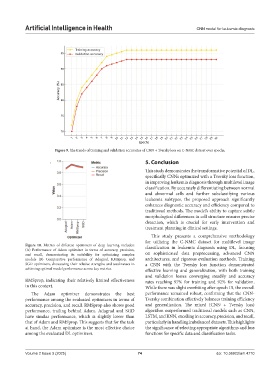
                        Figure 9. The trends of training and validation accuracies of CNN + Tversky loss on C-NMC dataset over epochs.

                                                               5. Conclusion
                                                               This study demonstrates the transformative potential of DL,
                                                               specifically CNNs optimized with a Tversky loss function,
                                                               in improving leukemia diagnosis through multilevel image
                                                               classification. By accurately differentiating between normal
                                                               and abnormal cells and further subclassifying various
                                                               leukemia  subtypes,  the  proposed  approach  significantly
                                                               enhances diagnostic accuracy and efficiency compared to
                                                               traditional methods. The model’s ability to capture subtle
                                                               morphological differences in cell structure ensures precise
                                                               detection, which is crucial for early intervention and
                                                               treatment planning in clinical settings.
                                                                 This study presents a comprehensive methodology
                                                               for  utilizing  the  C-NMC  dataset  for  multilevel  image
            Figure  10. Metrics of different optimizers of deep learning includes:   classification in leukemia diagnosis using DL, focusing
            (A)  Performance of Adam optimizer in terms of accuracy, precision,
            and recall, demonstrating its suitability for optimizing complex   on sophisticated data preprocessing, advanced CNN
            models (B)  Comparative performance of Adagrad, RMSprop, and   architectures, and rigorous evaluation methods. Training
            SGD optimizers, showcasing their relative strengths and weaknesses in   a CNN with the Tversky loss function demonstrated
            achieving optimal model performance across key metrics.  effective learning and generalization, with both training
                                                               and validation losses converging steadily and accuracy
            RMSprop, indicating their relatively limited effectiveness   rates reaching  97%  for  training  and  92%  for  validation.
            in this context.                                   While there was slight overfitting after epoch 15, the overall
              The Adam optimizer demonstrates the best         performance remained robust, confirming that the CNN-
            performance among the evaluated optimizers in terms of   Tversky combination effectively balances training efficiency
            accuracy, precision, and recall. RMSprop also shows good   and  generalization.  The  mixed  (CNN  +  Tversky  loss)
            performance, trailing behind Adam. Adagrad and SGD   algorithm outperformed traditional models such as CNN,
            have similar performance, which is slightly lower than   LSTM, and RNN, excelling in accuracy, precision, and recall,
            that of Adam and RMSprop. This suggests that for the task   particularly in handling imbalanced datasets. This highlights
            at hand, the Adam optimizer is the most effective choice   the significance of selecting appropriate algorithms and loss
            among the evaluated DL optimizers.                 functions for specific data and classification tasks.


            Volume 2 Issue 3 (2025)                         74                               doi: 10.36922/aih.4710

