


Page 89 - AIH-2-3
P. 89
Artificial Intelligence in Health                                  Organizational culture’s impact on burnout


            3. Data and methods                                30% test data. The models created 500 trees. In Model 1,
                                                               where question C30 served as the DV and was measured
            3.1. Setting, measurement, and study design        with questions B1, B5, B6, B7, B8, B9, B10, B11, B12, B15,
            This cross-sectional and exploratory study was approved   and B17, the model explained 6% of the variance. At each
            by the Harrisburg University of Science and Technology   split, three variables were tested based on the lowest mean
            Institutional Review Board (20221026). To construct   squared error (MSE). Model 1 reached approximately 1%
            a random forest model, the optimal sample size was   error after 500 trees, as shown in Table 1. The lowest MSE
            determined to be 570, as the model requires ten times the   was achieved with 27 trees. The lack of improvement in
            number of features (57) in the dataset.            performance after 27 trees indicates diminishing returns,
                                                               suggesting that a higher number of trees is not optimal
              A 57-item Likert scale survey, validated and reliable
            for measuring OC and burnout, developed by Kovner   for Model 1 and does not provide additional information.
                                                               In addition, the out-of-bag (OOB) score of 1.25 indicates
            et al. 33,34  was used for data collection. Detailed information   that approximately one out of the data left out of training
            regarding the instrument’s validated and reliability can be   was correctly predicted. A lower OOB score reflects better
            found in Kovner et al.’s 33,34  studies and in a previous study   performance, which aligns with the low MSE results.
            based on  the  same  dataset.   The  scale  was  modified to
                                  32
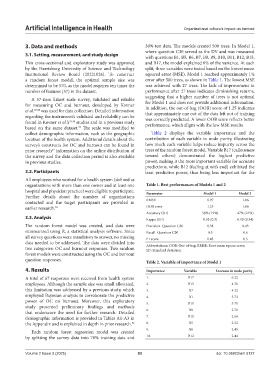
            collect demographic information, such as the geographic   Table 2 displays the variable importance and the
            location of the health system. Additional details about the   contribution of each variable to node purity, illustrating
            survey’s constructs for OC and burnout can be found in   how much each variable helps reduce impurity across the
                       32
            prior research  Information on the online distribution of   trees of the random forest model. Variable B17 (callousness
            the survey and the data collection period is also available   toward others) demonstrated the highest predictive
            in previous studies.                               power, making it the most important variable for accurate
                                                               predictions, while B12 (feeling at wit’s end) exhibited the
            3.2. Participants                                  least predictive power, thus being less important for the
            All employees who worked for a health system (defined as
            organizations with more than one owner and at least one   Table 1. Best performances of Models 1 and 2
            hospital and physician practice) were eligible to participate.   Parameter  Model 1        Model 2
            Further details about the number of organizations
            contacted and the target participants are provided in   RMSE                 0.97           1.06
            earlier research. 32                               OOB error                 1.25           1.06
                                                               Accuracy (SD)           58% (19%)      47% (21%)
            3.3. Analysis                                      Kappa (SD)              0.33 (0.3)     0.19 (0.34)
            The random forest model was created, and data were   Precision–Question C30  0.38           0.43
            summarized using R, a statistical analysis software. Since   Recall–Question C30  0.5       0.6
            all survey questions were mandatory to answer, no missing   F1 score         0.43           0.5
            data needed to be addressed. The data were divided into
            two categories: OC and burnout responses. Two random   Abbreviations: OOB: Out-of-bag; RMSE: Root mean square error;
                                                               SD: Standard deviation.
            forest models were constructed using the OC and burnout
            question responses.
                                                               Table 2. Variable of importance of Model 1
            4. Results                                         Importance      Variable      Increase in node purity
            A total of 67 responses were received from health system   1.        B17                6.22
            employees. Although the sample size was small alleviated,   2.       B15                4.76
            this limitation was addressed by a previous study, which   3.        B7                 4.32
            employed Bayesian analysis to corroborate the predictive   4.        B1                 3.73
            power of OC on burnout. Moreover, this exploratory   5.              B11                3.71
            study presented preliminary findings and methods
            that underscore the need for further research. Detailed   6.         B9                 2.70
            demographic information is provided in Tables A1-A3 in   7.          B10                2.68
            the Appendix and is explained in depth in prior research. 32  8.     B5                 2.52
              Each  random  forest regression  model  was  created   9.          B8                 2.45
            by splitting the survey data into 70% training data and   10.        B12                2.44


            Volume 2 Issue 3 (2025)                         83                               doi: 10.36922/aih.5127

