


Page 90 - AIH-2-3
P. 90
Artificial Intelligence in Health                                  Organizational culture’s impact on burnout


            accuracy of predictions. Due to its high node purity score,   as the splitting criterion. This model explained 17% of the
            B17 effectively split Model 1, reducing error in C30 scores.   variance. Model 2 exhibited an error of approximately 1%
            In contrast, B12, which showed a lower node purity score,   after reaching 500 trees, as shown in Table 1. However, the
            contributed less to reducing error in the model. B12 had   lowest MSE was achieved with 23 trees. The OOB score of
            fewer splits and a smaller reduction in impurity compared   1.25 indicates that approximately 1 out of the 30%of the
            to B17. The high node purity score for B17 was attributed   test data, which was left out, was correctly predicted. The
            to a moderate negative correlation of  -0.33 with C30.   low OOB score aligns with the low MSE.
            Conversely, the low node purity score for B12 reflected a   Similar to Model 1, a higher number of trees resulted
            weak negative correlation of  -0.19 with C30, suggesting   in diminished performance due to the lack of additional
            that B12 does not significantly explain variability in C30.  information provided beyond 23 trees. The variable of
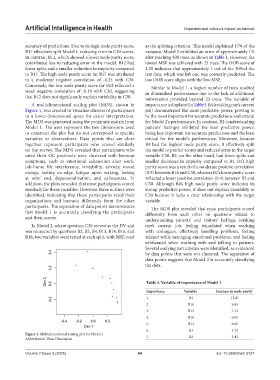
              A multidimensional scaling  plot (MDS), shown  in   importance is displayed in Table 3. B4 (retaking one’s current
            Figure 1, was created to visualize clusters of participants   job) demonstrated the most predictive power, proving to
            in a lower-dimensional space for easier interpretation.   be the most important for accurate predictions and critical
            The MDS was generated using the proximity matrix from   for Model 2’s performance. In contrast, B2 (understanding
            Model 1. The axes represent the two dimensions used   patients’ feelings) exhibited the least predictive power,
            to construct the plot but do not correspond to specific   being less important for accurate predictions and the least
            variables or observations. Data points that are close   critical for the model’s performance. Moreover, because
            together represent participants who scored similarly   B4 had the highest node purity score, it effectively split
            on the survey. The MDS revealed that participants who   the model to predict scores and reduced error in the target
            rated their OC positively were clustered with burnout   variable C30. B2, on the other hand, had fewer splits and
            symptoms, such as emotional exhaustion after work,   smaller decreases in impurity compared to B4. B4’s high
            job-home life interference, irritability, anxiety, mood   purity score was a result of a moderate positive correlation
            swings, feeling on-edge, fatigue upon waking, feeling   (0.5) between B14 and C30, whereas B2’s lower purity score
            at wits’ end, depersonalization, and callousness. In   reflected a lower positive correlation (0.4) between B2 and
            addition, the plots revealed that most participants scored   C30. Although B4’s high node purity score indicates its
            similarly for these variables. However, three outliers were   strong predictive power, it does not explain variability in
            identified, indicating that these participants rated their   C30 because it lacks a clear relationship with the target
            organizations and burnout differently from the other   variable.
            participants. The separation of data points demonstrates   The MDS plot revealed that most participants scored
            that Model 1 is accurately classifying the participants   differently from each other on questions related to
            and their scores.                                  understanding patients’ and visitors’ feelings, retaking
              In Model 2, where question C30 served as the DV and   one’s current job, feeling stimulated when working
            was measured by questions B2, B3, B4, B13, B14, B16, and   with colleagues, effectively handling problems, feeling
            B18, two variables were tested at each split, with MSE used   relaxed while managing emotional problems, and feeling
                                                               exhilarated when working with and talking to patients.
                                                               Several outlying participants were identified, as evidenced
                                                               by data points that were not clustered. The separation of
                                                               data points suggests that Model 2 is accurately classifying
                                                               the data.


                                                               Table 3. Variable of importance of Model 2

                                                               Importance      Variable      Increase in node purity
                                                               1.                B4                12.81
                                                               2.                B16                9.65
                                                               3.                B13                7.13
                                                               4.                B18                6.83
                                                               5.                B14                6.65
                                                               6.                B3                 4.34
            Figure 1. Multidimensional scaling plot for Model 1
            Abbreviation: Dim: Dimension.                      7.                B2                 3.43


            Volume 2 Issue 3 (2025)                         84                               doi: 10.36922/aih.5127

