


Page 13 - AJWEP-22-4
P. 13
IoT-based water quality monitoring

                protocol, allowing for local storage of sensor readings to   TDS EC meter, and the pH parameters were validated
                support offline analysis and historical data tracking. The   using a pH meter. The inputs to the developed system
                system incorporated a universal serial bus type-C (USB-  included sensors for pH, total dissolved solids (TDS),
                C) interface with a CH340G USB-to-serial converter,   and  temperature.  An  Arduino  microcontroller  was
                which  enabled  seamless  programming,  debugging,   used in the processing or control section. The output
                and power supply management. An auto-reset circuit,   section  included  a  data  recorder  (logger)  and  LCD
                controlled by request to send and data terminal ready   data. The block diagram of the temperature, TDS, and
                signals from the USB interface, automated the switching   pH parameters monitoring system was created using
                between reset and boot mode of ESP32 during firmware   an Arduino microcontroller.
                uploads,  thereby  enhancing  development  efficiency.   To  ensure  measurement  reliability,  each  sensor
                3.3 V and 5 V rails were carefully designed to supply   integrated  into the IoT-based monitoring system,
                stable power to the microcontroller, sensors, and   which measures pH, TDS, temperature, and turbidity,
                peripherals, ensuring reliable operation under varying   was subjected to individual calibration using traceable
                load conditions. Collectively, this integrated electronic   reference standards. The pH sensor was calibrated using
                scheme supports robust, scalable, and real-time water   a three-point method with commercial buffer solutions
                quality monitoring, making it suitable for deployment   (EZ-9908, Kedida, China) at pH 4.0, 7.0, and 10.0. The
                in diverse aquatic environments that require continuous   TDS sensor was calibrated using sodium chloride (NaCl)
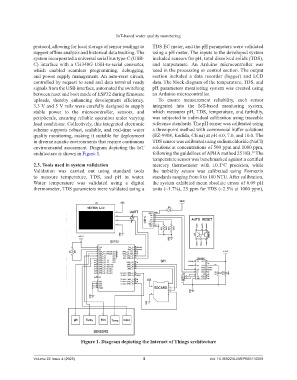
                environmental assessment. Diagram depicting the IoT   solutions at concentrations of 500 ppm and 1000 ppm,
                                                                                                                39
                architecture is shown in Figure 1.                  following the guidelines of APHA method 2510B.  The
                                                                    temperature sensor was benchmarked against a certified
                2.3. Tools used in system validation                mercury  thermometer  with ±0.1°C precision,  while
                Validation was carried out using standard tools     the  turbidity  sensor was calibrated  using  Formazin
                to measure temperature,  TDS, and pH in water.      standards ranging from 0 to 100 NTU. After calibration,
                Water temperature was validated  using a  digital   the system exhibited mean absolute errors of 0.09 pH
                thermometer, TDS parameters were validated using a   units (~1.7%), 25 ppm for TDS (~2.5% at 1000 ppm),


                                     Figure 1. Diagram depicting the Internet of Things architecture


                Volume 22 Issue 4 (2025)                        5                            doi: 10.36922/AJWEP025110069

