


Page 16 - AJWEP-22-4
P. 16
Ujianti, et al.

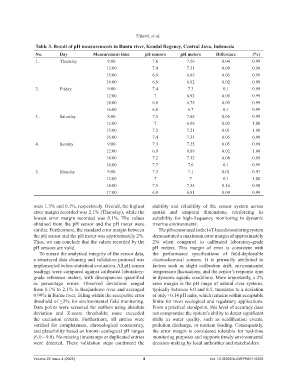
                 Table 3. Result of pH measurements in Buntu river, Kendal Regency, Central Java, Indonesia
                 No.       Day            Measurement time       pH sensors      pH meters      Difference      (%)
                 1.        Thursday             9:00                7.6            7.56            0.04         0.99
                                                12:00               7.4            7.31            0.09         0.99
                                                15:00               6.9            6.85            0.05         0.99
                                                16:00               6.9            6.82            0.02         0.99
                 2.        Friday               9:00                7.4             7.3            0.1          0.99
                                                12:00                7             6.92            0.08         0.99
                                                14:00               6.8            6.75            0.05         0.99
                                                16:00               6.8             6.7            0.1          0.99
                 3.        Saturday             8:00                7.5            7.45            0.05         0.99
                                                12:00                7             6.98            0.02         1.00
                                                15:00               7.2            7.21            0.01         1.00
                                                16:00               7.4            7.35            0.05         0.99
                 4.        Sunday               9:00                7.3            7.25            0.05         0.99
                                                12:00               6.9            6.88            0.02         1.00
                                                14:00               7.2            7.12            0.08         0.99
                                                16:00               7.7             7.6            0.1          0.99
                 5.        Monday               9:00                7.3             7.1            0.01         0.97
                                                12:00                7              7              0.1          1.00
                                                14:00               7.5            7.34            0.16         0.98
                                                17:00               6.9            6.81            0.09         0.99


                were 1.3% and 0.1%, respectively. Overall, the highest   stability  and reliability  of the sensor system across
                error margin recorded was 2.1% (Thursday), while the   spatial  and temporal  dimensions, reinforcing  its
                lowest error margin recorded was 0.1%.  The values   suitability  for high-frequency monitoring  in dynamic
                obtained  from  the  pH sensor and  the  pH meter  were   riverine environments.
                similar. Furthermore, the standard error margin between   The pH sensor used in the IoT-based monitoring system
                the pH sensor and the pH meter was approximately 2%.   demonstrated a maximum error margin of approximately
                Thus, we can conclude that the values recorded by the   2% when compared to calibrated laboratory-grade
                pH sensors are valid.                               pH  meters.  This  margin  of  error  is  consistent  with
                  To ensure the analytical integrity of the sensor data,   the  performance  specifications  of  field-deployable
                a structured data cleaning and validation protocol was   electrochemical sensors. It is primarily attributed to
                implemented before statistical evaluation. All pH sensor   factors such as slight calibration drift, environmental
                readings were compared against calibrated laboratory-  temperature fluctuations, and the sensor’s response time
                grade  reference  meters,  with  discrepancies  quantified   in dynamic aquatic conditions. More importantly, a 2%
                as  percentage  errors.  Observed deviations  ranged   error margin in the pH range of natural river systems,
                from 0.1% to 2.1% in Banjardowo river and averaged   typically between 6.0 and 8.5, translates to a deviation
                0.99% in Buntu river, falling within the acceptable error   of only ±0.14 pH units, which remains within acceptable
                threshold of ≤2% for environmental field monitoring.   limits for most ecological and regulatory applications.
                Data points were screened for outliers using absolute   From a practical standpoint, this level of accuracy does
                deviation  and Z-score thresholds; none exceeded    not compromise the system’s ability to detect significant
                the  exclusion  criteria.  Furthermore,  all  entries  were   shifts  in  water  quality,  such  as  acidification  events,
                verified  for  completeness,  chronological  consistency,   pollution discharge, or nutrient loading. Consequently,
                and plausibility based on known ecological pH ranges   the error margin is considered tolerable for real-time
                (6.0 – 9.0). No missing timestamps or duplicated entries   monitoring purposes and supports timely environmental
                were  detected.  These  validation  steps  confirmed  the   decision-making by local authorities and stakeholders.


                Volume 22 Issue 4 (2025)                        8                            doi: 10.36922/AJWEP025110069

