


Page 14 - AJWEP-22-4
P. 14
Ujianti, et al.

                0.4°C (~1.3%) for temperature, and 1.8 NTU (~3.6% at   2.4. Comparison of the proposed IoT-based water
                50 NTU) for turbidity – all within acceptable limits for   quality monitoring system with previous studies
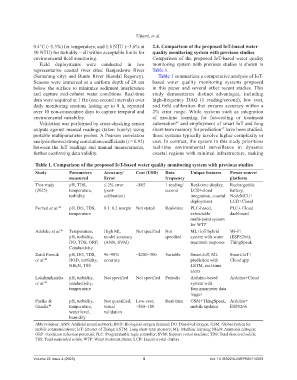
                environmental field monitoring.                     Comparison  of the  proposed IoT-based  water  quality
                  Field  deployments  were  conducted  in  two      monitoring system with previous studies is shown  in
                representative  coastal  river  sites:  Banjardowo  River   Table 1.
                (Semarang city) and Buntu River (Kendal Regency).      Table 1 summarizes a comparative analysis of IoT-
                Sensors were immersed at a uniform depth of 20 cm   based water quality monitoring systems proposed
                below  the  surface  to  minimize  sediment  interference   in this paper and several other recent studies.  This
                and capture mid-column water conditions. Real-time   study demonstrates distinct advantages, including
                data were acquired at 1 Hz (one-second intervals) over   high-frequency DAQ (1 reading/second), low cost,
                daily  monitoring  sessions lasting  up to 8  h, repeated   and  field  calibration  that  ensures  accuracy  within  a
                over 10 non-consecutive days to capture temporal and   2% error range.  While systems such as integration
                environmental variability.                          of machine learning for forecasting or treatment
                  Validation was performed by cross-checking sensor   automation  and employment of smart IoT and long
                                                                              45
                outputs against  manual  readings  (taken  hourly) using   short-term memory for prediction  have been studied,
                                                                                                   42
                portable multiparameter probes. A Pearson correlation   those systems typically involve higher complexity or
                analysis showed strong correlation coefficients (r ≥ 0.95)   cost. In contrast, the system in this study prioritizes
                between  the  IoT readings  and manual  measurements,   real-time environmental surveillance in dynamic
                further confirming data validity.                   coastal regions with minimal infrastructure, making

                 Table 1. Comparison of the proposed IoT-based water quality monitoring system with previous studies
                 Study         Parameters      Accuracy/     Cost (USD)   Data       Unique features  Power source/
                               measured        Error                      frequency                   platform
                 This study    pH, TDS,        ≤ 2% error    ~$85         1 reading/  Real-time display,   Rechargeable
                 (2025)        temperature,    (post-                     second     LCD+cloud        battery,
                               turbidity       calibration)                          integration, coastal  NodeMCU+
                                                                                     deployment       LCD+Cloud
                 Forhad et al. 40  pH, DO, TDS,   0.1–0.2 margin Not stated  Real-time  PLC-based,    PLC+ Cloud
                               temperature                                           extendable       dashboard
                                                                                     multi-point system
                                                                                     for WTP
                 Adeleke et al. 41  Temperature,   High ML   Not specified  Not      ML+IoT hybrid    Wi-Fi
                               pH, turbidity,   model accuracy            specified  system with water   (ESP8266),
                               DO, TDS, ORP,  (ANN, SVM)                             treatment response  ThingSpeak
                               Conductivity
                 Zaidi Farouk   pH, DO, TDS,   96–98%        ~$200–300    Variable   Smart-IoT, ML    Smart-IoT+
                 et al. 42     BOD, turbidity,   accuracy                            prediction with   Cloud app
                               NH₃N, TSS                                             LSTM, real-time
                                                                                     alerts
                 Lakshmikantha   pH, turbidity,   Not specified  Not specified  Periodic  Arduino-based   Arduino+Cloud
                 et al. 43     conductivity,                                         system with
                               temperature                                           four-parameter data
                                                                                     logger
                 Pasika &      pH, turbidity,   Not quantified;  Low-cost;   Real-time  GSM+ThingSpeak,  Arduino+
                 Gandla 44     temperature,    visual        ~$60–100                mobile updates   ESP8266
                               water level,    validation
                               humidity
                 Abbreviations: ANN: Artificial neural network; BOD: Biological oxygen demand; DO: Dissolved oxygen; GSM: Global system for
                 mobile communications; IoT: Internet of Things; LSTM: Long short-term memory; ML: Machine learning; NH 3N: Ammonia nitrogen;
                 ORP: Oxidation reduction potential; PLC: Programmable logic controller; SVM: Support vector machine; TDS: Total dissolved solids;
                 TSS: Total suspended solids; WTP: Water treatment plants; LCD: Liquid crystal display.


                Volume 22 Issue 4 (2025)                        6                            doi: 10.36922/AJWEP025110069

