


Page 18 - AJWEP-22-4
P. 18
Ujianti, et al.

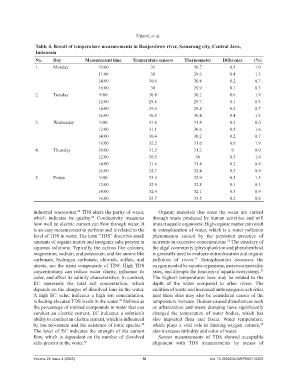
                 Table 4. Result of temperature measurements in Banjardowo river, Semarang city, Central Java,
                 Indonesia

                 No.     Day           Measurement time    Temperature sensors    Thermometer      Difference    (%)
                 1.      Monday             10:00                  31                 30.7            0.3        1.0
                                            11:00                  30                 29.6            0.4        1.3
                                            14:00                  30.6               30.8            0.2        0.7
                                            16:00                  30                 29.9            0.1        0.3
                 2.      Tuesday             9:00                  30.8               30.2            0.6        1.9
                                            12:00                  29.8               29.7            0.1        0.3
                                            14:00                  29.6               29.4            0.2        0.7
                                            16:00                  30.8               30.4            0.4        1.3
                 3.      Wednesday           9:00                  31.6               31.4            0.2        0.6
                                            12:00                  31.1               30.6            0.5        1.6
                                            14:00                  30.4               30.2            0.2        0.7
                                            16:00                  32.2               31.6            0.6        1.9
                 4.      Thursday           10:00                  31.2               31.2             0         0.0
                                            12:00                  30.5                30             0.5        1.6
                                            14:00                  31.6               31.4            0.2        0.6
                                            16:00                  32.7               32.4            0.3        0.9
                 5.      Friday              9:00                  33.4               32.9            0.5        1.5
                                            12:00                  32.9               32.8            0.1        0.3
                                            14:00                  32.4               32.1            0.3        0.9
                                            16:00                  33.7               33.5            0.2        0.6

                industrial wastewater.  TDS alters the purity of water,   Organic  materials  that  enter the water are carried
                                   54
                which indicates its quality.  Conductivity  measures   through waste produced by human activities and will
                                         48
                how well an electric current can flow through water. It   impact aquatic organisms. High organic matter can result
                is an easy measurement to perform and is related to the   in eutrophication of water, which is a water pollution
                level of TDS in water. The term “TDS” describes small   phenomenon  caused by the persistent  presence  of
                amounts of organic matter and inorganic salts present in   nutrients in excessive concentrations.  The structure of
                                                                                                     52
                aqueous solutions. Typically, the cations like calcium,   the algal community (phytoplankton and phytobenthos)
                magnesium, sodium, and potassium, and the anions like   is generally used to evaluate eutrophication and organic
                carbonate,  hydrogen carbonate, chloride,  sulfate, and   pollution of rivers.  Eutrophication  decreases the
                                                                                       53
                nitrate, are the main components of TDS. High TDS   oxygen needed by aquatic organisms, increases mortality
                concentrations  can  reduce  water  clarity,  influence  its   rates, and disrupts the function of aquatic ecosystems.
                                                                                                                    55
                color, and affect its salinity characteristics. In contrast,   The highest temperatures  here may be related  to the
                EC represents the total salt concentration,  which   depth of the water compared to other rivers.  The
                depends on the charges of dissolved ions in the water.   addition of waste and increased anthropogenic activities
                A  high EC value indicates  a high ion concentration,   near these sites may also be considered causes of the
                reflecting elevated TDS levels in the water.  Defined as   temperature increase. Human-caused disturbances such
                                                     49
                the percentage of ionized compounds in water that can   as urbanization and waste dumping have significantly
                conduct  an  electric  current,  EC  indicates  a  solution’s   changed the temperature  of water bodies, which has
                ability to conduct an electric current, which is influenced   also  impacted  flora  and  fauna.  Water  temperature,
                by ion movement and the existence of ionic species.    which plays a vital role in limiting oxygen content,
                                                               48
                                                                                                                    54
                The  level  of EC indicates  the  strength  of the  current   also increases turbidity and color of water.
                flow, which is dependent on the number of dissolved    Sensor measurements  of  TDS showed acceptable
                salts present in the water. 50                      alignment  with  TDS measurements  by means of


                Volume 22 Issue 4 (2025)                        10                           doi: 10.36922/AJWEP025110069

