


Page 19 - AJWEP-22-4
P. 19
IoT-based water quality monitoring

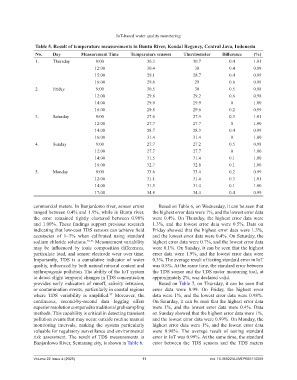
                 Table 5. Result of temperature measurements in Buntu River, Kendal Regency, Central Java, Indonesia
                 No.    Day          Measurement Time      Temperature sensors    Thermometer      Difference    (%)
                 1.     Thursday           9:00                   30.3                30.7            0.4        1.01
                                           12:00                  30.4                 30             0.4        0.99
                                           15:00                  29.1                28.7            0.4        0.99
                                           16:00                  29.6                 29             0.6        0.98
                 2.     Friday             9:00                   30.5                 30             0.5        0.98
                                           12:00                  29.8                29.2            0.6        0.98
                                           14:00                  29.9                29.9             0         1.00
                                           16:00                  29.8                29.6            0.2        0.99
                 3.     Saturday           9:00                   27.6                27.9            0.3        1.01
                                           12:00                  27.7                27.7             0         1.00
                                           14:00                  28.7                28.3            0.4        0.99
                                           16:00                  31.4                31.4             0         1.00
                 4.     Sunday             9:00                   27.7                27.2            0.5        0.98
                                           12:00                  27.7                27.7             0         1.00
                                           14:00                  31.5                31.4            0.1        1.00
                                           16:00                  32.7                32.8            0.1        1.00
                 5.     Monday             9:00                   33.6                33.4            0.2        0.99
                                           12:00                  31.1                31.4            0.3        1.01
                                           14:00                  31.5                31.4            0.1        1.00
                                           17:00                  34.8                34.4            0.4        0.99


                commercial meters. In Banjardowo river, sensor errors   Based on Table 6, on Wednesday, it can be seen that
                ranged between 0.4% and 1.9%, while in Buntu river,   the highest error data were 1%, and the lowest error data
                the error remained  tightly  clustered  between 0.98%   were 0.4%. On Thursday, the highest error data were
                and  1.00%.  These  findings  support  previous  research   1.3%, and the lowest error data were 0.5%. Data on
                indicating that low-cost TDS sensors can achieve field   Friday showed that the highest error data were 1.3%,
                accuracies  of  1–3%  when  calibrated  using  standard   and the lowest error data were 0.4%. On Saturday, the
                sodium chloride solutions. 55,56  Measurement variability   highest error data were 0.7%, and the lowest error data
                may  be  influenced  by  ionic  composition  differences,   were 0.1%. On Sunday, it can be seen that the highest
                particulate load, and sensor electrode wear over time.   error data were 1.9%, and the lowest error data were
                Importantly,  TDS is a cumulative  indicator  of water   0.3%. The average result of testing standard error in IoT
                quality, influenced by both natural mineral content and   was 0.8%. At the same time, the standard error between
                anthropogenic pollution. The ability of the IoT system   the TDS sensor and the TDS meter measuring tool, at
                to detect slight temporal changes in TDS concentration   approximately 2%, was declared valid.
                provides  early  indicators  of  runoff,  salinity  intrusion,   Based on Table 7, on Thursday, it can be seen that
                or contamination events, particularly in coastal regions   error  data  were  0.99.  On Friday,  the  highest  error
                where  TDS  variability  is  amplified.  Moreover, the   data were 1%, and the lowest error data were 0.98%.
                                                 57
                continuous,  second-by-second  data  logging  offers   On Saturday, it can be seen that the highest error data
                superior resolution compared to traditional grab sampling   were 1%, and the lowest error data were 0.4%. Data
                methods. This capability is critical in detecting transient   on Sunday showed that the highest error data were 1%,
                pollution events that may occur outside routine manual   and the lowest error data were 0.99%. On Monday, the
                monitoring  intervals, making the system particularly   highest error data were 1%, and the lowest error data
                valuable for regulatory surveillance and environmental   were 0.98%.  The average  result of testing standard
                risk assessment.  The result of  TDS measurements  in   error in IoT was 0.99%. At the same time, the standard
                Banjardowo River, Semarang city, is shown in Table 6.  error between the  TDS sensors and the  TDS meters


                Volume 22 Issue 4 (2025)                        11                           doi: 10.36922/AJWEP025110069

