


Page 232 - AJWEP-22-4
P. 232
Lv, et al.

                ratio reflects the extent of financial resources that a firm   ownership concentration and management shareholding
                can freely allocate and utilize.                    ratio reflect the equity distribution within the company,
                                                                    while the size of the board of directors determines the
                4.2.4. Control variable                             strategic decision-making ability of a company, and the
                Referring to the research of Zhao and Lee  and Shang   number of R&D personnel reflects the personnel structure
                                                     10
                et al.,  this study selected control variables from two   of a company. These four indicators effectively measure
                     44
                aspects,  corporate  finance  and  corporate  governance,   the governance capacity of a company and can reflect
                to represent a corporate ESG Gws behavior. Financial   how the company makes real environmental investment
                variables at the company level included enterprise size   decisions, which may affect Gws behavior, under the
                (Size),  current  ratio  (Cr),  asset  turnover  (Ato),  book-  control  of  various  stakeholders.  The  description  of
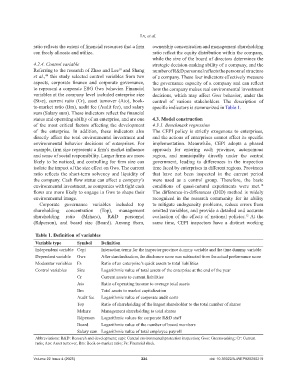
                to-market ratio (Bm), audit fee (Audit fee), and salary   specific indicators is summarized in Table 1.
                sum (Salary sum). These indicators reflect the financial
                status and operating ability of an enterprise, and are one   4.3. Model construction
                of the most critical factors affecting the development   4.3.1. Benchmark regression
                of the enterprise. In addition, these indicators  also   The  CEPI  policy  is  strictly  exogenous  to  enterprises,
                directly affect the total environmental investment and   and the actions of enterprises cannot affect its specific
                environmental  behavior  decisions  of  enterprises.  For   implementation.  Meanwhile,  CEPI  adopts  a  phased
                example, firm size represents a firm’s market influence   approach for entering  each province, autonomous
                and sense of social responsibility. Larger firms are more   region, and municipality  directly  under the central
                likely to be noticed, and controlling for firm size can   government,  leading  to  differences  in  the  inspection
                isolate the impact of the size effect on Gws. The current   time faced by enterprises in different regions. Provinces
                ratio  reflects  the  short-term  solvency  and  liquidity  of   that  have  not  been  inspected  in  the  current  period
                the company. Cash flow status can affect a company’s   were  used  as  a  control  group.  Therefore,  the  basic
                environmental investment, as companies with tight cash   conditions  of  quasi-natural  experiments  were  met.
                                                                                                                    14
                flows are more likely to engage in Gws to shape their   The difference-in-differences (DID) method is widely
                environmental image.                                recognized  in  the  research  community  for  its  ability
                  Corporate  governance  variables  included  top   to mitigate endogeneity problems, reduce errors from
                shareholding  concentration   (Top),  management    omitted variables, and provide a detailed and accurate
                shareholding  ratio  (Mshare),  R&D     personnel   evaluation of the effects of national policies.  At the
                                                                                                             12
                (Rdperson),  and  board  size  (Board).  Among  them,   same  time,  CEPI  inspectors  have  a  distinct  working


                 Table 1. Definition of variables
                 Variable type     Symbol     Definition
                 Independent variable Cepi    Interaction terms for the inspector province dummy variable and the time dummy variable
                 Dependent variable  Gws      After standardization, the disclosure score was subtracted from the actual performance score
                 Moderator variables  Fs      Ratio of an enterprise’s quick assets to total liabilities
                 Control variables  Size      Logarithmic value of total assets of the enterprise at the end of the year
                                   Cr         Current assets to current liabilities
                                   Ato        Ratio of operating income to average total assets
                                   Bm         Total assets to market capitalization
                                   Audit fee  Logarithmic value of corporate audit costs
                                   Top        Ratio of shareholding of the largest shareholder to the total number of shares
                                   Mshare     Management shareholding to total shares
                                   Rdperson   Logarithmic values for corporate R&D staff
                                   Board      Logarithmic value of the number of board members
                                   Salary sum Logarithmic value of total employee payroll
                 Abbreviations: R&D: Research and development; cepi: Central environmental protection inspection; Gws: Greenwashing; Cr: Current
                 ratio; Ato: Asset turnover, Bm: Book-to-market ratio; Fs: Financial slack.


                Volume 22 Issue 4 (2025)                       224                           doi: 10.36922/AJWEP025280219

