


Page 233 - AJWEP-22-4
P. 233
CEPI & ESG greenwashing: Exec. attention view

                time, which is coordinated and arranged by the central   correlation  analysis  was  conducted  using  Stata  18
                government. Characterized by a high level of authority   (StataCorp,  United  States).  A  p<0.1  was  considered
                and  strong  enforcement,  these  inspections  are  less   statistically significant.
                susceptible to external factors and thus represent a form
                of effective policy impact.  Therefore, the DID model   5. Empirical result analysis
                                       12
                was employed in this study, the control variables were
                added, and the time and industry information were fixed   Table  2 presents the descriptive  statistics  for each
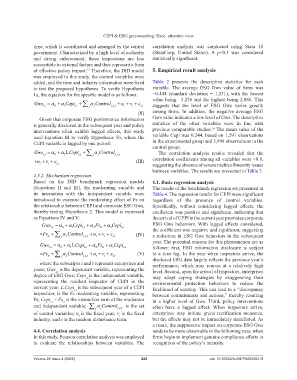
                to test the proposed hypotheses. To verify Hypothesis   variable.  The  average  ESG  Gws  value  of  firms  was
                1a, the equation for the specific model is as follows:  −0.444  (standard  deviation  =  1.231),  with  the  lowest
                Gws  , i t  α =  0  α +  1 Cepi i t , ∑  j α +  j Control j ,,i t  +  t  +u  i  ε + v  , i t    value being −3.250 and the highest being 2.866. This
                                                                    suggests  that  the  level  of  ESG  Gws  varies  greatly
                                                              (II)  among  firms.  In  addition,  the  negative  average  ESG
                  Given that corporate ESG performance information   Gws value indicates a low level of Gws. The descriptive
                is generally disclosed in the subsequent year and policy   statistics  of  the  other  variables  were  in  line  with
                                                                                              14
                interventions  often  exhibit  lagged  effects,  this  study   previous comparable studies.  The mean value of the
                used Equation Ⅲ to verify Hypothesis 1b, where the   variable Cepi was 0.244, based on 1,291 observations
                CEPI variable is lagged by one period:              in the experimental group and 3,998 observations in the
                                                                    control group.
                       α =  α +Gws  . L Cepi , ∑  α +  Control         The correlation analysis results revealed  that the
                    , i t  0  1     i t   j  j      j ,,i t
                +  t  +u  i  +v  ε , i t                     (III)  correlation coefficients among all variables were <0.8,
                                                                    suggesting the absence of severe multicollinearity issues
                                                                    between variables. The results are presented in Table 3.
                4.3.2. Mechanism regression
                Based  on  the  DID  benchmark  regression  models   5.1. Basic regression analysis
                (Equations  Ⅱ  and  Ⅲ),  the  moderating  variable  and   The results of the benchmark regression are presented in
                its  interaction  with  the  independent  variable  were   Table 4. The regression results for CEPI were significant
                introduced to examine the moderating effect of Fs on   regardless  of  the  presence  of  control  variables.
                the relationship between CEPI and corporate ESG Gws,   Specifically,  without  considering  lagged  effects,  the
                thereby testing Hypothesis 2. This model is expressed   coefficient was positive and significant, indicating that
                as Equations Ⅳ and Ⅴ:                               the arrival of CEPI in the current year promotes corporate
                     Gws  , i t  α =  0  α +  1  , i t  α +Cepi  2 Fs it  α +  3 Cepi  , i t  ESG  Gws  behaviors.  With  lagged  effects  considered,
                   ×  it  + Fs  ∑  j α  j  j ,,i t  +  t  +u  i  + v  ε Control  , i t     (IV)  the coefficient was negative and significant, suggesting
                                                                    a reduction in ESG Gws behaviors in the subsequent
                          α = Gws  α +  . L Cepi  α +  Fs  α +  Cepi  year. The potential reasons for this phenomenon are as
                       , i t  0  1     , i t  2  it  3  , i t       follows:  first,  ESG  information  disclosure  is  subject
                   ×  it  + Fs  ∑  j α  j  j ,,i t  +  t  +u  i  + v  ε Control  , i t  (V)  to a time lag. In the year when inspectors arrive, the
                  where the subscripts i and t represent enterprises and   disclosed ESG data largely reflects the previous year’s
                                                                    performance,  which  may  remain  at  a  relatively  high
                years; Gws  is the dependent variable, representing the   level. Second, upon the arrival of inspectors, enterprises
                          i,t
                degree of ESG Gws; Cepi is the independent variable,   may  adopt  coping  strategies  by  exaggerating  their
                                       i,t
                representing  the  resident  inspector  of CEPI in  the   environmental  protection  behaviors  to  reduce  the
                current year; L.Cepi is the subsequent year of a CEPI   likelihood of scrutiny. This can lead to a “discrepancy
                                  i,t
                inspection; is the Fs moderating variable, representing   between commitments and actions,” thereby resulting
                Fs; Cepi  × Fs  is the interaction term of the moderator   in  a  higher  level  of  Gws.  Third,  policy  interventions
                       i,t
                             it
                and independent variable;  ∑  j α Control  j ,,i t   is the set   often  have  a  lagged  effect.  When  inspectors  arrive,
                                             j
                of control variables; u  is the fixed year; v  is the fixed   enterprises  may  initiate  green  rectification  measures,
                                    t
                                                      i
                industry; and ε is the random disturbance term.     but the effects may not be immediately manifested. As
                                                                    a result, the suppressive impact on corporate ESG Gws
                4.4. Correlation analysis                           tends to be more observable in the following year, when
                In this study, Pearson correlation analysis was employed   firms begin to implement genuine compliance efforts in
                to  evaluate  the  relationships  between  variables.  The   recognition of the policy’s intensity.


                Volume 22 Issue 4 (2025)                       225                           doi: 10.36922/AJWEP025280219

