


Page 234 - AJWEP-22-4
P. 234
Lv, et al.

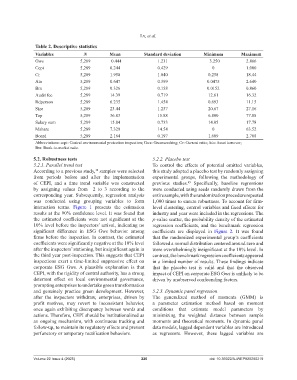
                 Table 2. Descriptive statistics
                 Variables            N          Mean           Standard deviation         Minimum         Maximum
                 Gws                5,289        −0.444               1.231                 −3.250           2.866
                 Cepi               5,289        0.244                0.429                   0              1.000
                 Cr                 5,289        1.950                1.840                  0.258           18.44
                 Ato                5,289        0.647                0.399                 0.0475           2.640
                 Bm                 5,289        0.326                0.158                 0.0152           0.860
                 Audit fee          5,289        14.39                0.719                  12.61           16.32
                 Rdperson           5,289        6.235                1.454                  0.693           11.15
                 Size               5,289        23.44                1.237                  20.67           27.16
                 Top                5,289        36.83                15.88                  6.800           77.88
                 Salary sum         5,289        15.84                0.733                  14.05           17.78
                 Mshare             5,289        7.329                14.54                   0              63.52
                 Board              5,289        2.164                0.197                  1.609           2.708
                 Abbreviations: cepi: Central environmental protection inspection; Gws: Greenwashing; Cr: Current ratio; Ato: Asset turnover;
                 Bm: Book-to-market ratio.

                5.2. Robustness tests                               5.2.2. Placebo test
                5.2.1. Parallel trend test                          To  control  the  effects  of  potential  omitted  variables,
                According to a previous study,  samples were selected   this study adopted a placebo test by randomly assigning
                                           10
                from  periods  before  and  after  the  implementation   experimental  groups,  following  the  methodology  of
                of  CEPI,  and  a  time  trend  variable  was  constructed   previous  studies.   Specifically,  baseline  regressions
                                                                                    45
                by  assigning  values  from  −2  to  3  according  to  the   were conducted using seeds randomly drawn from the
                corresponding  year.  Subsequently,  regression  analysis   entire sample, with the randomization procedure repeated
                was  conducted  using  grouping  variables  to  form   1,000 times to ensure robustness. To account for firm-
                interaction  terms.  Figure  1  presents the estimation   level clustering, control variables and fixed effects for
                results at the 90% confidence level. It was found that   industry and year were included in the regressions. The
                the  estimated  coefficients  were  not  significant  at  the   p-value scatter, the probability density of the estimated
                10% level before the inspectors’ arrival, indicating no   regression  coefficients,  and  the  benchmark  regression
                significant  difference  in  ESG  Gws  behavior  among   coefficients  are  displayed  in  Figure  2.  It  was  found
                firms before the inspection. In contrast, the estimated   that the randomized experimental group’s coefficients
                coefficients were significantly negative at the 10% level   followed a normal distribution centered around zero and
                after the inspectors’ stationing, but insignificant again in   were overwhelmingly insignificant at the 10% level. In
                the third year post-inspection. This suggests that CEPI   contrast, the benchmark regression coefficients appeared
                inspections  exert  a  time-limited suppressive  effect  on   in a limited number of results. These findings indicate
                corporate  ESG  Gws.  A  plausible  explanation  is  that   that  the  placebo  test  is  valid  and  that  the  observed
                CEPI, with the rigidity of central authority, has a strong   impact of CEPI on corporate ESG Gws is unlikely to be
                deterrent  effect  on  local  environmental  governance,   driven by unobserved confounding factors.
                prompting enterprises to undertake green transformation
                and  genuinely  practice  green  development.  However,   5.2.3. Dynamic panel regression
                after  the  inspectors  withdraw,  enterprises,  driven  by   The  generalized  method  of  moments  (GMM)  is
                profit  motives,  may  revert  to  inconsistent  behavior,   a  parameter  estimation  method  based  on  moment
                once again exhibiting discrepancy between words and   conditions  that  estimate  model  parameters  by
                actions. Therefore, CEPI should be institutionalized as   minimizing  the  weighted  distance  between  sample
                an ongoing mechanism, with continuous tracking and   moments  and theoretical  moments.  In dynamic  panel
                follow-up, to maintain its regulatory effects and prevent   data models, lagged dependent variables are introduced
                perfunctory or temporary rectification behaviors.   as  regressors.  However,  these  lagged  variables  are


                Volume 22 Issue 4 (2025)                       226                           doi: 10.36922/AJWEP025280219

