


Page 239 - AJWEP-22-4
P. 239
CEPI & ESG greenwashing: Exec. attention view

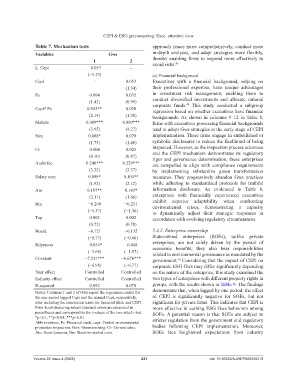
                 Table 7. Mechanism tests                           approach issues more comprehensively, conduct more
                 Variables                       Gws                in-depth  analyses,  and  adapt  strategies  more  flexibly,
                                          1               2         thereby enabling firms to respond more effectively to
                                                                              45
                 L. Cepi                −0.053            -         avoid risks.
                                        (−1.23)                     (c) Financial background
                 Cepi                     -             0.053       Executives  with  a  financial  background,  relying  on
                                                        (1.34)      their  professional  expertise,  have  unique  advantages
                 Fs                     0.064           0.035       in  investment  risk  management,  enabling  them  to
                                        (1.42)          (0.99)      conduct  diversified  investments  and  allocate  rational
                                                                    corporate  funds.   This  study  conducted  a  subgroup
                                                                                   48
                 Cepi* Fs              0.042**          0.020       regression based on whether executives have financial
                                        (2.14)          (1.00)      backgrounds. As  shown  in  columns  9–12  in Table  8,
                 Mshare                0.009***        0.009***     firms with executives possessing financial backgrounds
                                        (3.95)          (4.27)      tend to adopt Gws strategies at the early stage of CEPI
                 Size                   0.088*          0.070       implementation. These firms engage in embellished or
                                        (1.73)          (1.46)      symbolic disclosures to reduce the likelihood of being
                 Cr                     0.004           0.025       inspected. However, as the inspection process advances
                                        (0.10)          (0.87)      and the CEPI mechanism  demonstrates  its regulatory
                                                                    rigor and governance determination, these enterprises
                 Audit fee             0.240***        0.229***     are compelled to  align with compliance requirements
                                        (3.32)          (3.37)      by  implementing  substantive  green  transformation
                 Salary sum             0.099*         0.104**      measures. They  progressively  abandon  Gws  practices
                                        (1.92)          (2.12)      while  adhering  to  standardized  protocols  for  truthful
                 Ato                   0.187**          0.143*      information  disclosure.  As evidenced  in  Table  8,
                                        (2.11)          (1.66)      enterprises  with  financially  experienced  executives
                 Bm                     −0.269          −0.251      exhibit  superior  adaptability  when  confronting
                                                                    environmental  crises, demonstrating  a capacity
                                        (−1.37)         (−1.36)     to dynamically  adjust their  strategic  responses in
                 Top                    0.002           0.002       accordance with evolving regulatory circumstances.
                                        (0.72)          (0.78)
                 Board                  −0.121          −0.135      5.4.2. Enterprise ownership
                                        (−0.77)         (−0.90)     State-owned  enterprises  (SOEs),  unlike  private
                 Rdperson              −0.054*          −0.048      enterprises,  are  not  solely  driven  by  the  pursuit  of
                                        (−1.69)         (−1.57)     economic  benefits;  they  also  bear  responsibilities
                                                                    related to environmental governance as mandated by the
                 Constant             −7.211***       −6.676***     government.  Considering that the impact of CEPI on
                                                                               49
                                        (−6.98)         (−6.77)     corporate ESG Gws may differ significantly depending
                 Year effect          Controlled      Controlled    on the nature of the enterprise, this study examined the
                 Industry effect      Controlled      Controlled    two types of enterprises with different property rights in
                 R-squared              0.092           0.078       groups, with the results shown in Table 9. The findings
                 Notes: Columns 1 and 2 of Gws report the regression results for   demonstrate that, when lagged by one period, the effect
                 the one-period lagged Cepi and the normal Cepi, respectively,   of  CEPI  is  significantly  negative  for  SOEs,  but  not
                 after including the interaction terms for financial slack and CEPI.   significant for private firms. This indicates that CEPI is
                 Firm-level clustering robust standard errors are presented in   more effective in curbing ESG Gws behaviors among
                 parentheses and correspond to the t-values of the two-sided t-test.   SOEs. A  potential  reason  is  that  SOEs  are  subject  to
                 *p<0.1, **p<0.05, ***p<0.01.
                 Abbreviations: Fs: Financial slack; cepi: Central environmental   stricter regulation from the government and regulatory
                 protection inspection; Gws: Greenwashing; Cr: Current ratio;   bodies  following  CEPI  implementation.  Moreover,
                 Ato: Asset turnover, Bm: Book-to-market ratio.     SOEs  face  heightened  expectations  from  industry


                Volume 22 Issue 4 (2025)                       231                           doi: 10.36922/AJWEP025280219

