


Page 241 - AJWEP-22-4
P. 241
CEPI & ESG greenwashing: Exec. attention view

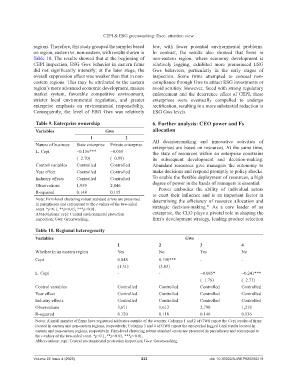
                regions. Therefore, this study grouped the samples based   low,  with  fewer  potential  environmental  problems.
                on region, eastern vs. non-eastern, with results shown in   In  contrast,  the  results  also  showed  that  firms  in
                Table 10. The results showed that at the beginning of   non-eastern  region,  where  economy  development  is
                CEPI inspection, ESG Gws behavior in eastern firms   relatively  lagging,  exhibited  more  pronounced  ESG
                did  not  significantly  intensify;  at  the  later  stage,  the   Gws  behaviors,  particularly  in  the  early  stages  of
                overall suppression effect was weaker than that in non-  inspection.  Some  firms  attempted  to  conceal  non-
                eastern regions. This may be attributed to the eastern   compliance through Gws to attract ESG investments or
                region’s more advanced economic development, mature   avoid scrutiny. However, faced with strong regulatory
                market  system,  favorable  competitive  environment,   enforcement  and  the  deterrence  effect  of  CEPI,  these
                stricter local environmental  regulation, and greater   enterprises  were  eventually  compelled  to  undergo
                enterprise  emphasis  on  environmental  responsibility.   rectification, resulting in a more substantial reduction in
                Consequently,  the  level  of  ESG  Gws  was  relatively   ESG Gws levels.

                 Table 9. Enterprise ownership                      6. Further analysis: CEO power and Fs
                 Variables                     Gws                  allocation
                                         1              2
                 Nature of business  State enterprise  Private enterprise  All  decision-making  and  innovative  activities  of
                                                                    enterprises are based on resources. At the same time,
                 L. Cepi           −0.156***      −0.058            the  state  of  resources  within  an  enterprise  constrains
                                   (−2.70)        (−0.99)           its  subsequent  development  and  decision-making.
                 Control variables  Controlled    Controlled        Abundant  resources  give  managers  the  autonomy  to
                 Year effect       Controlled     Controlled        make decisions and respond promptly to policy shocks.
                 Industry effects  Controlled     Controlled        To enable the flexible deployment of resources, a high
                 Observations      1,959          2,046             degree of power in the hands of managers is essential.
                                                                       Power  embodies  the  ability  of  individual  actors
                 R-squared         0.148          0.115             to  exert  their  influence  and  is  an  important  factor  in
                 Note: Firm-level clustering robust standard errors are presented   determining  the  efficiency  of  resource  allocation  and
                 in parentheses and correspond to the t-values of the two-sided             51
                 t-test. *p<0.1, **p<0.05, ***p<0.01.               strategic  decision-making.   As  a core leader of an
                 Abbreviations: cepi: Central environmental protection   enterprise, the CEO plays a pivotal role in shaping the
                 inspection; Gws: Greenwashing.                     firm’s development strategy, leading product selection

                 Table 10. Regional heterogeneity
                 Variables                                                         Gws
                                                     1                 2                 3                 4
                 Whether in an eastern region        Yes               No                Yes               No
                 Cepi                                0.048             0.196***          -                 -
                                                     (1.31)            (3.03)
                 L. Cepi                             -                 -                 −0.085*           −0.241***
                                                                                         (−1.76)           (−2.73)
                 Control variables                   Controlled        Controlled        Controlled        Controlled
                 Year effect                         Controlled        Controlled        Controlled        Controlled
                 Industry effects                    Controlled        Controlled        Controlled        Controlled
                 Observations                        3,671             1,612             2,790             1,218
                 R-squared                           0.120             0.118             0.146             0.136
                 Notes: A small number of firms have registered addresses outside of the country. Columns 1 and 2 of GWS report the Cepi results of firms
                 located in eastern and non-eastern regions, respectively; Columns 3 and 4 of GWS report the one-period lagged Cepi results located in
                 eastern and non-eastern regions, respectively. Firm-level clustering robust standard errors are presented in parentheses and correspond to
                 the t-values of the two-sided t-test. *p<0.1, **p<0.05, ***p<0.01.
                 Abbreviations: cepi: Central environmental protection inspection; Gws: Greenwashing.


                Volume 22 Issue 4 (2025)                       233                           doi: 10.36922/AJWEP025280219

