


Page 242 - AJWEP-22-4
P. 242
Lv, et al.

                and R&D, and promoting policy implementation.        Table 11. Indicators for Chief Executive Officer
                                                               52
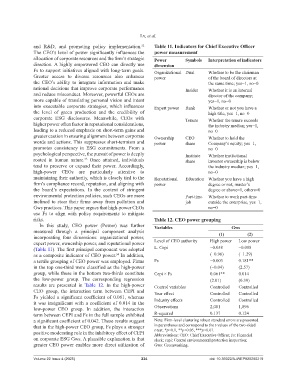
                The CEO’s level of power significantly influences the   power measurement
                allocation of corporate resources and the firm’s strategic   Power   Symbols  Interpretation of indicators
                direction. A highly empowered CEO can directly use   dimension
                Fs to support initiatives aligned with long-term goals.   Organizational  Dual  Whether to be the chairman
                Greater  access  to  diverse  resources  also  enhances   power              of the board of directors at
                the  CEO’s  ability  to  integrate  information  and  make                   the same time; yes=1, no=0
                rational decisions that improve corporate performance              Insider   Whether it is an internal
                and reduce misconduct. Moreover, powerful CEOs are                           director of the company;
                more capable of translating personal vision and intent                       yes=1, no=0
                into  executable  corporate  strategies,  which  influences   Expert power  Rank  Whether or not you have a
                the  level  of  green  production  and  the  credibility  of                 high title, yes=1, no=0
                corporate  ESG  disclosures.  Meanwhile,  CEOs  with               Tenure    Whether the tenure exceeds
                higher power often factor in reputational considerations,                    the industry median; yes=1,
                leading to a reduced emphasis on short-term gains and                        no=0
                greater caution in ensuring alignment between corporate   Ownership   CEO    Whether to hold the
                words and actions. This suppresses short-termism and   power       share     Company’s equity; yes=1,
                promotes  consistency  in  ESG  commitments.  From  a                        no=0
                psychological perspective, the pursuit of power is deeply          Institute   Whether institutional
                rooted in human nature.   Once  attained,  individuals             share     investor ownership is below
                                      53
                tend  to  preserve  or  expand  their  power. Accordingly,                   the industry median; yes=1,
                high-power  CEOs  are  particularly  attentive  to                           no=0
                maintaining their authority, which is closely tied to the   Reputational   Education Whether you have a high
                firm’s compliance record, reputation, and aligning with   power              degree or not, master’s
                the  board’s  expectations.  In  the  context  of  stringent                 degree or above=1, others=0
                environmental protection policies, such CEOs are more              Part-time   Whether to work part-time
                inclined  to  steer  their  firms  away  from  pollution  and      job       outside the enterprise, yes=1,
                Gws practices. This paper argues that high-power CEOs                        no=0
                use  Fs  to  align  with  policy  requirements  to  mitigate
                risks.                                               Table 12. CEO power grouping
                  In  this  study,  CEO  power  (Power)  was  further   Variables                      Gws
                measured through a principal  component  analysis                                (1)          (2)
                incorporating  four  dimensions:  organizational  power,
                expert power, ownership power, and reputational power   Level of CEO authority  High power  Low power
                (Table 11). The first principal component was adopted   L. Cepi               −0.058      −0.088
                as a composite indicator of CEO power.  In addition,                          (−0.96)     (−1.29)
                                                    54
                a tertile grouping of CEO power was employed. Firms   Fs                      −0.003      0.181**
                in the top one-third were classified as the high-power                        (−0.04)     (2.57)
                group, while those in the bottom two-thirds constitute   Cepi × Fs            0.061**     0.014
                the  low-power  group.  The  corresponding  regression                        (2.01)      (0.39)
                results are presented in  Table  12.  In  the  high-power   Control variables  Controlled  Controlled
                CEO  group,  the  interaction  term  between  CEPI  and   Year effect         Controlled  Controlled
                Fs  yielded  a  significant  coefficient  of  0.061,  whereas
                it  was  insignificant  with  a  coefficient  of  0.014  in  the   Industry effects  Controlled  Controlled
                low-power  CEO  group.  In  addition,  the  interaction   Observations        2,081       1,896
                term between CEPI and Fs in the full sample exhibited   R-squared             0.137       0.124
                a significant coefficient of 0.042. These results suggest   Note: Firm-level clustering robust standard errors are presented
                that in the high-power CEO group, Fs plays a stronger   in parentheses and correspond to the t-values of the two-sided
                positive moderating role in the inhibitory effect of CEPI   t-test. *p<0.1, **p<0.05, ***p<0.01.
                                                                     Abbreviations: CEO: Chief Executive Officer; Fs: Financial
                on corporate ESG Gws. A plausible explanation is that   slack; cepi: Central environmental protection inspection;
                greater CEO power enables more direct utilization of   Gws: Greenwashing.


                Volume 22 Issue 4 (2025)                       234                           doi: 10.36922/AJWEP025280219

