


Page 149 - AJWEP-22-5
P. 149
Climate trend and policy in Lake Tana Basin


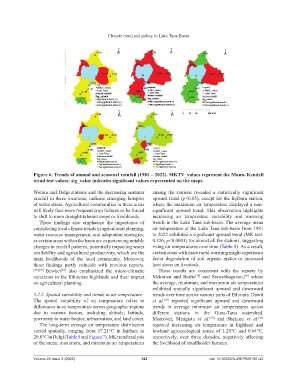
                Figure 6. Trends of annual and seasonal rainfall (1981 – 2022). MKTV_values represent the Mann–Kendall
                trend test values; sig_value indicates significant values represented on the maps.


                Woreta and Delgi stations and the decreasing summer   among  the  stations  revealed  a  statistically  significant
                rainfall in these locations, indicate emerging hotspots   upward trend (p<0.05), except for the Injibara station,
                of water stress. Agricultural communities in these areas   where the maximum air temperature displayed a non-
                will likely face more frequent crop failures or be forced   significant  upward  trend.  This  observation  highlights
                to shift to more drought-tolerant crops or livelihoods.  increasing  air  temperature  variability  and  warming
                  These  findings  also  emphasize  the  importance  of   trends in the Lake Tana sub-basin. The average mean
                considering local climate trends in agricultural planning,   air temperature at the Lake Tana sub-basin from 1981
                water resource management, and adaptation strategies,   to 2022 exhibited a significant upward trend (MK test:
                as certain areas within the basin are experiencing notable   0.526; p<0.0001) for almost all the stations, suggesting
                changes in rainfall patterns, potentially impacting water   rising air temperatures over time (Table 5). As a result,
                availability and agricultural productivity, which are the   certain areas with more rapid warming might experience
                main  livelihoods of the  local  community. Moreover,   faster degradation of soil organic matter  or increased
                these  findings  partly  coincide  with  previous  reports.  heat stress on livestock.
                [49],[57]  Bewket  also emphasized the micro-climatic   These  results  are  consistent  with  the  reports  by
                            [67]
                                                                                       [10]
                variations in the Ethiopian highlands and their impact   Mekonen  and  Berlie  and  Suryabhagavan,  where
                                                                                                            [56]
                on agricultural planning.                           the average, minimum, and maximum air temperatures
                                                                    exhibited  spatially  significant  upward  and  downward
                3.2.2. Spatial variability and trends in air temperature  trends over time across various parts of Ethiopia. Dawit
                The spatial  variability  of air temperature  refers to   et al.   reported  significant  upward  and  downward
                                                                         [63]
                differences in air temperature across geographic regions   trends in average minimum  air temperatures  across
                due  to  various  factors,  including  altitude,  latitude,   different  stations  in  the  Guna-Tana  watershed.
                proximity to water bodies, urbanization, and land cover.  Moreover, Mengistu  et  al.   and  Shekuru  et  al.
                                                                                                                   [49]
                                                                                             [50]
                  The long-term average air temperature distribution   reported  increasing  air temperature  in highland  and
                varied  spatially,  ranging  from  17.21°C  in  Injibara  to   lowland  agroecological  zones of 1.28°C and  0.64°C,
                20.8°C in Delgi (Table 5 and Figure 7). MK trend analysis   respectively,  over  three  decades,  negatively  affecting
                of the mean, maximum, and minimum air temperatures   the livelihood of smallholder farmers.


                Volume 22 Issue 5 (2025)                       143                           doi: 10.36922/AJWEP025190142

