


Page 145 - AJWEP-22-5
P. 145
Climate trend and policy in Lake Tana Basin

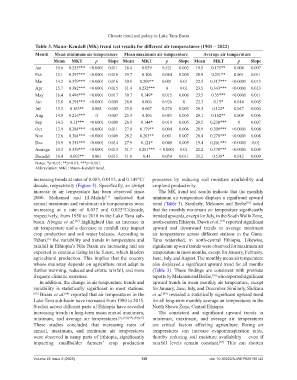
                 Table 3. Mann–Kendall (MK) trend test results for different air temperatures (1901 – 2022)
                 Month   Mean minimum air temperature   Mean maximum air temperature       Average air temperature
                         Mean    MKT       p     Slope Mean    MKT        p     Slope  Mean    MKT        p    Slope
                 Jan     10.6  0.255*** <0.0001  0.011  28.4    0.039   0.521   0.002  19.5   0.175**   0.004   0.007
                 Feb     12.1  0.297*** <0.0001  0.016  29.7    0.106   0.084   0.005  20.9   0.211**   0.001   0.011
                 Mar     14.2  0.379*** <0.0001  0.016  30.9   0.209**  0.001   0.01   22.5   0.317***  <0.0001  0.013
                 Apr     15.7  0.382*** <0.0001  0.015  31.4  0.232***    0     0.01   23.5   0.343***  <0.0001  0.013
                 May     16.4  0.498*** <0.0001  0.017  30.7   0.149*   0.015   0.006  23.5   0.35***  <0.0001  0.011
                 Jun     15.8  0.291*** <0.0001  0.009  28.8    0.006   0.926     0    22.3    0.15*    0.014   0.005
                 Jul     15.3   0.163**  0.008   0.005  25.8    0.067   0.276   0.003  20.5    0.122*   0.047   0.004
                 Aug     14.9  0.216***    0     0.007  25.3    0.106   0.083   0.005  20.1   0.162**   0.008   0.006
                 Sep     14.3   0.31***  <0.0001  0.008  26.8  0.144*   0.019   0.005  20.5   0.238***    0     0.007
                 Oct     13.9  0.384*** <0.0001  0.011  27.9   0.179**  0.004   0.006  20.9   0.309***  <0.0001  0.008
                 Nov     12.6  0.304*** <0.0001  0.009  28.2   0.203**  0.001   0.007  20.4   0.279***  <0.0001  0.008
                 Dec     10.9  0.354*** <0.0001  0.014  27.9   0.121*   0.049   0.005  19.4   0.261***  <0.0001  0.01
                 Average  10.3  0.339*** <0.0001  0.013  31.7  0.251*** < 0.0001  0.01  21.2  0.378***  <0.0001  0.008
                 Decadal  10.4  0.692**  0.001   0.015  31.8    0.41    0.059   0.011  21.2    0.538*   0.012   0.009
                 Notes: *p<0.05; **p<0.01; ***p<0.001.
                 Abbreviation: MKT: Mann–Kendall trend.

                increasing trends at rates of 0.083, 0.0113, and 0.149°C/  processes by reducing soil moisture availability  and
                decade, respectively (Figure 5). Specifically, an abrupt   cropland productivity.
                increase  in air temperature  has been observed since   The MK trend test results indicate that the monthly
                2000. Mohamed and  El-Mahdy  indicated  that        minimum air temperature displays a significant upward
                                               [11]
                annual maximum and minimum air temperatures were    trend (Table 3). Similarly, Mekonen and Berlie  noted
                                                                                                             [10]
                increasing at a rate of 0.037 and 0.025°C/decade,   that the monthly minimum air temperature significantly
                respectively, from 1950 to 2018 in the Lake Tana sub-  trended upwards, except for July, in the South Wollo Zone,
                basin. Abegaz et al.  highlighted that an increase in   north-eastern Ethiopia. Dawit et al.,  reported significant
                                  [62]
                                                                                                  [63]
                air temperature and a decrease in rainfall may impact   upward and downward trends in average minimum
                crop production and soil water balance. According to   air  temperatures  across  different  stations  in  the  Guna-
                Tabari,  the variability and trends in temperature and   Tana watershed, in north-central Ethiopia. Likewise,
                      [6]
                rainfall in Ethiopia’s Nile Basin are increasing and are   significant upward trends were observed for maximum air
                expected to continue rising in the future, which hinders   temperature in most months, except for January, February,
                agricultural  production. This  implies  that  the  country   June, July, and August. The monthly mean air temperature
                whose mainstay depends on agriculture must adapt to   also displayed a significant upward trend for all months
                further warming, reduced and erratic rainfall, and more   (Table  3).  These  findings  are  consistent  with  previous
                frequent climatic extremes.                         reports by Mekonen and Berlie,  who reported significant
                                                                                              [10]
                  In addition, the change in air temperature trends and   upward trends in mean monthly air temperature, except
                variability  is  statistically  significant  in  most  stations.  for January, June, July, and December. Similarly, Shekuru
                             [64]
                [63]  Birara et al.  reported that air temperatures in the   et al.  revealed a statistically significant upward trend
                                                                         [49]
                Lake Tana sub-basin have increased from 1980 to 2015.   for all long-term monthly average air temperatures in the
                Studies across different parts of Ethiopia have revealed   North Shewa Zone, Central Ethiopia.
                increasing trends in long-term mean annual maximum,    The  consistent  and  significant  upward  trends  in
                minimum,  and average  air  temperatures. [9],[10],[49],[50],[57]    minimum,  maximum, and average  air temperatures
                These studies concluded  that increasing  rates of   are  critical  factors  affecting  agriculture.  Rising  air
                annual,  maximum,  and  minimum  air  temperatures   temperatures  can increase  evapotranspiration  rates,
                were observed in many parts of Ethiopia, significantly   thereby  reducing  soil moisture availability  – even  if
                impacting  smallholder  farmers’  crop  production   rainfall  levels remain constant.   This can shorten
                                                                                                  [65]


                Volume 22 Issue 5 (2025)                       139                           doi: 10.36922/AJWEP025190142

