


Page 173 - AJWEP-22-5
P. 173
Alleviating aluminum toxicity

                indicates that Al stress induces an increase in flavonoid   A        B         C
                metabolites in wheat, which primarily assist in binding
                Al ions and solubilizing P in the soil, thereby reducing
                Al uptake.  These findings underscore the importance
                         25
                of flavonoids in enhancing plant resilience to Al stress
                and improving P availability in acidic soils.
                  Metabolomics can be used to identify metabolic
                phenotypes, obtain qualitative and quantitative  data
                on many metabolites,  construct  metabolic  networks,
                and predict the functions of metabolites.  Multivariate
                                                    26
                statistical analysis and liquid chromatography-tandem
                mass spectrometry  (LC-MS/MS) have revealed
                significant  differences  in  flavonoids  in  Coreopsis
                tinctoria  from  different  production  areas.  Different
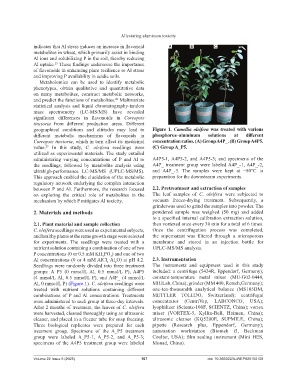
                geographical  conditions  and  altitudes  may  lead  to   Figure  1.  Camellia oleifera was treated with various
                different  metabolic  mechanisms  of  flavonoids  in   phosphorus–aluminum   solutions   at   different
                Coreopsis tinctoria, which in turn affect its medicinal   concentration ratios. (A) Group A4P_. (B) Group A4P5.
                value.  In this study,  C. oleifera seedlings were   (C) Group A_P5.
                     27
                utilized as experimental materials. The study entailed
                administering  varying  concentrations  of P and  Al to   A4P5-1, A4P5-2,  and A4P5-3; and specimens of the
                the seedlings, followed by metabolite  analysis using   A4P_ treatment group were labeled A4P_-1, A4P_-2,
                ultrahigh-performance  LC-MS/MS (UPLC-MS/MS).       and  A4P_-3.  The  samples  were  kept  at  −80°C  in
                This approach enabled the elucidation of the metabolic   preparation for the downstream experiments.
                regulatory network underlying the complex interaction
                between P and Al. Furthermore, the research focused   2.2. Pretreatment and extraction of samples
                on exploring  the critical  role of metabolites  in the   The leaf samples of  C. oleifera were subjected to
                mechanism by which P mitigates Al toxicity.         vacuum freeze-drying treatment. Subsequently, a
                                                                    grinderwas used to grind the samples into powder. The
                2. Materials and methods                            powdered  sample  was  weighed  (50  mg)  and  added
                                                                    to a specified internal calibration extraction solution,
                2.1. Plant material and sample collection           then vortexed once every 30 min for a total of 6 times.
                C. oleifera seedlings were used as experimental subjects,   Once the centrifugation process was completed,
                and healthy plants at the same growth stage were selected   the  supernatant  was  filtered  through  a  microporous
                for experiments.  The seedlings were treated  with a   membrane and stored in an injection bottle for
                nutrient solution containing a combination of one of two   UPLC-MS/MS analysis.
                P concentrations (0 or 0.5 mM KH PO ) and one of two
                                              2
                                                  4
                Al concentrations (0 or 4 mM AlCl ·Al O) at pH 4.2.   2.3. Instrumentation
                                                3
                                                    2
                Seedlings were randomly divided into three treatment   The instruments and equipment  used in this study
                groups:  A_P5  (0 mmol/L  Al, 0.5  mmol/L P),  A4P5   included: a centrifuge (5424R, Eppendorf, Germany);
                (4  mmol/L Al, 0.5 mmol/L P), and A4P_ (4  mmol/L   constant-temperature  metal  mixer  (MU-G02-0448,
                Al, 0 mmol/L P) (Figure 1). C. oleifera seedlings were   MIULab, China); grinder (MM 400, Retsch,Germany);
                treated  with  nutrient  solutions  containing  different   one-ten-thousandth analytical balance (MS105DM,
                combinations  of P and Al concentrations.  Treatments   METTLER  TOLEDO, Switzerland); centrifugal
                were administered to each group at three-day intervals.   concentrator (CentriVap, LABCONCO, USA);
                After 2 months of treatment, the leaves of C. oleifera   lyophilizer (Scientz-100F, SCIENTZ, China); vortex
                were harvested, cleaned thoroughly using an ultrasonic   mixer (VORTEX-5, Kyllin-Bell, Haimen, China);
                cleaner, and placed in a freezer tube for snap freezing.   ultrasonic cleaner (KQ5200E, SUPMILE, China);
                Three biological replicates  were prepared for each   pipette (Research plus, Eppendorf, Germany);
                treatment  group. Specimens  of the  A_P5 treatment   automation workstation (Biomek i5, Beckman
                group  were  labeled  A_P5-1, A_P5-2,  and A_P5-3;   Coulter,  USA);  film  sealing  instrument  (Mini  HES,
                specimens of the A4P5 treatment group were labeled   Monad, China).


                Volume 22 Issue 5 (2025)                       167                          doi: 10.366922/AJWEP025150108

