


Page 178 - AJWEP-22-5
P. 178
Wang, et al.

                              A                                     B


                                            C


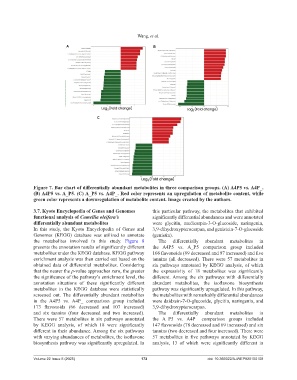
                Figure 7. Bar chart of differentially abundant metabolites in three comparison groups. (A) A4P5 vs. A4P_.
                (B) A4P5 vs. A_P5. (C) A_P5 vs. A4P_. Red color represents an upregulation of metabolite content, while
                green color represents a downregulation of metabolite content. Image created by the authors.

                3.7. Kyoto Encyclopedia of Genes and Genomes        this particular pathway, the metabolites that exhibited
                functional analysis of Camellia oleifera’s          significantly differential abundances and were annotated
                differentially abundant metabolites                 were  glycitin,  medicarpin-3-O-glucoside,  naringenin,
                In this study, the Kyoto Encyclopedia  of Genes and   3,9-dihydroxypterocarpan, and genistein-7-O-glucoside
                Genomes (KEGG) database  was utilized  to annotate   (genistin).
                the metabolites  involved in this study.  Figure  8    The   differentially   abundant   metabolites   in
                presents the annotation results of significantly different   the  A4P5  vs.  A_P5  comparison group included
                metabolites under the KEGG database. KEGG pathway   166 flavonoids (69 decreased and 97 increased) and five
                enrichment analysis was then carried out based on the   tannins (all decreased). There were 57 metabolites in
                obtained  data  of  differential  metabolites.  Considering   six pathways annotated  by KEGG analysis, of which
                that the nearer the p-value approaches zero, the greater   the  expressivity  of  18  metabolites  was  significantly
                the significance of the pathway’s enrichment level, the   different. Among  the  six  pathways  with  differentially
                annotation  situations  of  these  significantly  different   abundant  metabolites,  the  isoflavone  biosynthesis
                metabolites  in the KEGG database  were statistically   pathway was significantly upregulated. In this pathway,
                screened  out.  The  differentially  abundant  metabolites   the metabolites with remarkably differential abundances
                in the  A4P5  vs.  A4P_ comparison group included   were daidzein-7-O-glucoside, glycitin, naringenin, and
                173  flavonoids  (66  decreased  and  107  increased)   3,9-dihydroxypterocarpan.
                and six tannins (four decreased and two increased).    The   differentially   abundant   metabolites   in
                There were 57 metabolites in six pathways annotated   the  A_P5  vs.  A4P_ comparison  groups included
                by  KEGG  analysis,  of  which  18  were  significantly   147 flavonoids (78 decreased and 69 increased) and six
                different in their abundance. Among the six pathways   tannins (two decreased and four increased). There were
                with varying abundances of metabolites, the isoflavone   57  metabolites  in  five  pathways  annotated  by  KEGG
                biosynthesis pathway was significantly upregulated. In   analysis,  13  of  which  were  significantly  different  in


                Volume 22 Issue 5 (2025)                       172                          doi: 10.366922/AJWEP025150108

