


Page 180 - AJWEP-22-5
P. 180
Wang, et al.

                              A


                              B


                              C


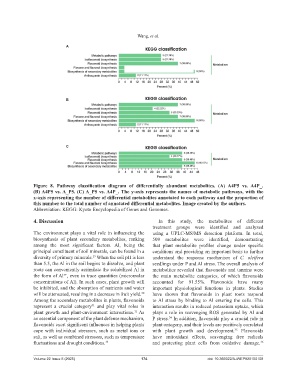
                Figure  8.  Pathway  classification  diagram  of  differentially  abundant  metabolites.  (A)  A4P5  vs.  A4P_.
                (B) A4P5 vs. A_P5. (C) A_P5 vs. A4P_. The y-axis represents the names of metabolic pathways, with the
                x-axis representing the number of differential metabolites annotated to each pathway and the proportion of
                this number to the total number of annotated differential metabolites. Image created by the authors.
                Abbreviation: KEGG: Kyoto Encyclopedia of Genes and Genomes.


                4. Discussion                                          In  this  study,  the  metabolites  of  different
                                                                    treatment  groups  were  identified  and  analyzed
                The environment plays a vital role in influencing the   using a UPLC-MS/MS  detection  platform. In total,
                biosynthesis of plant  secondary metabolites,  ranking   509  metabolites  were  identified,  demonstrating
                among  the  most  significant  factors.  Al,  being  the   that  plant  metabolite  profiles  change  under  specific
                principal constituent of soil minerals, can be found in a   conditions and providing an important basis to further
                diversity of primary minerals.  When the soil pH is less   understand the response mechanism  of C. oleifera
                                          29
                than 5.5, the Al in the soil begins to dissolve, and plant   seedlings under P and Al stress. The overall analysis of
                roots can conveniently assimilate the solubilized Al in   metabolites revealed that flavonoids and tannins were
                the form of Al³⁺, even in trace quantities (micromolar   the  main  metabolite  categories,  of  which  flavonoids
                concentrations of Al). In such cases, plant growth will   accounted  for 91.55%. Flavonoids have many
                be inhibited, and the absorption of nutrients and water   important  physiological  functions in plants. Studies
                will be attenuated, resulting in a decrease in fruit yield.    have  shown  that  flavonoids  in  plant  roots  respond
                                                               30
                Among the secondary metabolites in plants, flavonoids   to Al stress by binding  to Al entering  the  cells. This
                represent  a  crucial  category   and  play  vital  roles  in   interaction results in reduced potassium uptake, which
                                         31
                plant growth and plant-environment interactions.  As   plays a role in scavenging ROS generated by Al and
                                                            32
                an essential component of the plant defense mechanism,   P stress.  In addition, flavonoids play a crucial role in
                                                                           34
                flavonoids exert significant influences in helping plants   plant ontogeny, and their levels are positively correlated
                cope with individual  stressors, such as metal  ions or   with plant  growth and development.  Flavonoids
                                                                                                        35
                salt, as well as combined stressors, such as temperature   have  antioxidant  effects,  scavenging  free  radicals
                fluctuations and drought conditions. 33             and protecting  plant  cells  from oxidative  damage.
                                                                                                                    36


                Volume 22 Issue 5 (2025)                       174                          doi: 10.366922/AJWEP025150108

