


Page 175 - AJWEP-22-5
P. 175
Alleviating aluminum toxicity

                              A                                  B


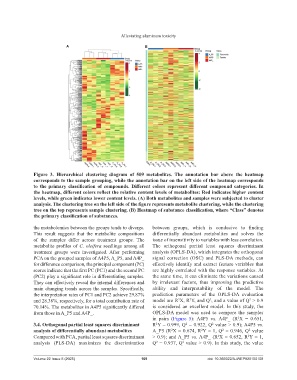
                Figure  3. Hierarchical  clustering  diagram of 509 metabolites.  The annotation bar above the heatmap
                corresponds to the sample grouping, while the annotation bar on the left side of the heatmap corresponds
                to  the  primary  classification  of  compounds.  Different  colors  represent  different  compound  categories.  In
                the heatmap, different colors reflect the relative content levels of metabolites: Red indicates higher content
                levels, while green indicates lower content levels. (A) Both metabolites and samples were subjected to cluster
                analysis. The clustering tree on the left side of the figure represents metabolite clustering, while the clustering
                tree on the top represents sample clustering. (B) Heatmap of substance classification, where “Class” denotes
                the primary classification of substances.

                the metabolomics between the groups tends to diverge.   between  groups,  which  is  conducive  to  finding
                This result suggests that the metabolite compositions   differentially  abundant  metabolites  and  solves  the
                of  the  samples  differ  across  treatment  groups.  The   issue of insensitivity to variables with less correlation.
                metabolite  profiles  of  C. oleifera seedlings among all   The orthogonal partial least squares discriminant
                treatment groups were investigated.  After performing   analysis (OPLS-DA), which integrates the orthogonal
                PCA on the grouped samples of A4P5, A_P5, and A4P_   signal correction (OSC) and PLS-DA methods, can
                for difference comparison, the principal component (PC)   effectively identify and extract feature variables that
                scores indicate that the first PC (PC1) and the second PC   are highly correlated with the response variables. At
                (PC2) play a significant role in differentiating samples.   the same time, it can eliminate the variations caused
                They can effectively reveal the internal differences and   by irrelevant factors, thus improving the predictive
                main changing trends across the samples. Specifically,   ability and interpretability of the model.  The
                the interpretation rates of PC1 and PC2 achieve 29.87%   prediction parameters of the OPLS-DA evaluation
                                                                                             2
                                                                                     2
                                                                                2
                                                                                                               2
                and 28.38%, respectively, for a total contribution rate of   model are R X, R Y, and Q , and a value of Q  > 0.9
                70.14%. The metabolites in A4P5 significantly differed   is considered an excellent model. In this study, the
                from those in A_P5 and A4P_.                        OPLS-DA model was used to compare the samples
                                                                    in pairs (Figure  5): A4P5  vs. A4P_  (R X = 0.651,
                                                                                                          2
                3.4. Orthogonal partial least squares discriminant   R Y = 0.999, Q  = 0.922, Q  value > 0.9); A4P5 vs.
                                                                                   2
                                                                                              2
                                                                      2
                analysis of differentially abundant metabolites     A_P5 (R X = 0.674, R Y = 1, Q  = 0.946, Q  value
                                                                                                               2
                                                                                                   2
                                                                                          2
                                                                            2
                Compared with PCA, partial least squares discriminant   > 0.9); and A_P5 vs. A4P_ (R X = 0.652, R Y = 1,
                                                                                                              2
                                                                                                 2
                analysis (PLS-DA) maximizes the discrimination      Q  = 0.937, Q  value > 0.9). In this study, the value
                                                                      2
                                                                                 2
                Volume 22 Issue 5 (2025)                       169                          doi: 10.366922/AJWEP025150108

