


Page 174 - AJWEP-22-5
P. 174
Wang, et al.

                2.4. UPLC-MS/MS conditions                          MWDB, qualitative  and  quantitative  analyses  of  the
                A UPLC-MS/MS instrument  system (ExionLC™           metabolites in C. oleifera samples are carried out. The
                AD,SCIEX,USA) was employed for analysis. The        MRM  mode was employed for metabolite  detection
                same chromatographic column model as described by   to accurately  determine  the compounds contained  in
                Wang et al. was used. Gradient elution was performed   the C. oleifera samples. The results are presented in a
                          24
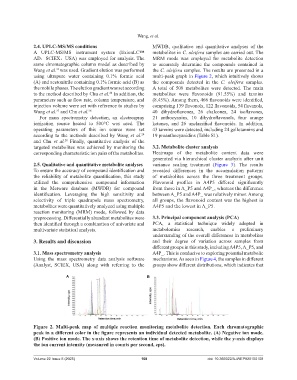
                using ultrapure  water  containing  0.1% formic  acid   multi-peak graph in Figure 2, which intuitively shows
                (A) and acetonitrile containing 0.1% formic acid (B) as   the compounds detected  in the  C. oleifera samples.
                the mobile phases. The elution gradient was set according   A  total of 509 metabolites  were detected.  The main
                to the method described by Chu et al.  In addition, the   metabolites  were  flavonoids  (91.55%)  and  tannins
                                                 28
                parameters such as flow rate, column temperature, and   (8.45%). Among them, 466 flavonoids were identified,
                injection volume were set with reference to studies by   comprising 139 flavonols, 122 flavonoids, 54 flavanols,
                Wang et al.  and Chu et al. 28                      40  dihydroflavones,  26  chalcones,  24  isoflavones,
                          27
                  For mass spectrometry  detection,  an electrospray   21  anthocyanins,  10  dihydroflavonols,  four  orange
                ionization  source  heated  to  500°C  was  used.  The   ketones,  and  26  unclassified  flavonoids.  In  addition,
                operating  parameters  of this ion source were set   43 tannins were detected, including 24 gallotannins and
                according to the methods described by  Wang  et al.    19 proanthocyanidins (Table S1).
                                                               24
                and Chu  et al.  Finally, quantitative  analysis of the
                              28
                targeted  metabolites  was achieved  by monitoring  the   3.2. Metabolite cluster analysis
                corresponding characteristic ion pairs of the metabolites.  Heatmaps of the metabolite content data were
                                                                    generated via hierarchical cluster analysis after unit
                2.5. Qualitative and quantitative metabolite analyses  variance  scaling treatment  (Figure  3). The  results
                To ensure the accuracy of compound identification and   revealed  differences  in  the  accumulation  patterns
                the  reliability  of  metabolite  quantification,  this  study   of metabolites across the three treatment groups.
                utilized  the  comprehensive  compound  information   Flavonoid  profiles  in  A4P5  differed  significantly
                in the Metware database  (MWDB) for compound        from those in A_P5 and A4P_, whereas the difference
                identification.  Leveraging  the  high  sensitivity  and   between A_P5 and A4P_ was relatively minor. Among
                selectivity  of triple  quadrupole  mass spectrometry,   all groups, the flavonoid content was the highest in
                metabolites were quantitatively analyzed using multiple   A4P5 and the lowest in A_P5.
                reaction  monitoring  (MRM) mode,  followed  by data
                preprocessing. Differentially abundant metabolites were   3.3. Principal component analysis (PCA)
                then identified through a combination of univariate and   PCA, a statistical technique widely adopted in
                multivariate statistical analysis.                  metabolomics   research,  enables  a   preliminary
                                                                    understanding of the overall differences in metabolites
                3. Results and discussion                           and their degree of variation across samples from
                                                                    different groups in this study, including A4P5, A_P5, and
                3.1. Mass spectrometry analysis                     A4P_. This is conducive to exploring potential metabolic
                Using the  mass spectrometry  data  analysis  software   mechanisms. As seen in Figure 4, the samples in different
                (Analyst, SCIEX, USA)  along with referring to the   groups show different distributions, which indicates that

                              A                                   B


                Figure  2.  Multi-peak  map of multiple  reaction  monitoring  metabolite  detection.  Each  chromatographic
                peak in a different color in the figure represents an individual detected metabolite. (A) Negative ion mode.
                (B) Positive ion mode. The x-axis shows the retention time of metabolite detection, while the y-axis displays
                the ion current intensity (measured in counts per second, cps).


                Volume 22 Issue 5 (2025)                       168                          doi: 10.366922/AJWEP025150108

