


Page 176 - AJWEP-22-5
P. 176
Wang, et al.

                              A                                        B


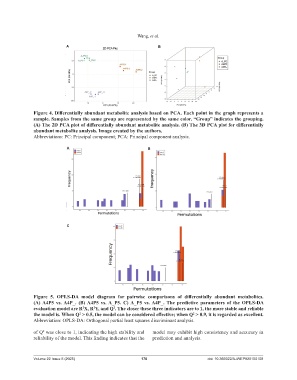
                Figure 4. Differentially abundant metabolite analysis based on PCA. Each point in the graph represents a
                sample. Samples from the same group are represented by the same color. “Group” indicates the grouping.
                (A) The 2D PCA plot of differentially abundant metabolite analysis. (B) The 3D PCA plot for differentially
                abundant metabolite analysis. Image created by the authors.
                Abbreviations: PC: Principal component; PCA: Principal component analysis.


                              A                                   B


                              C


                Figure  5.  OPLS-DA  model  diagram  for  pairwise  comparisons  of  differentially  abundant  metabolites.
                (A) A4P5  vs. A4P_.  (B) A4P5  vs. A_P5.  C) A_P5  vs. A4P_.  The  predictive  parameters  of  the  OPLS-DA
                evaluation model are R X, R Y, and Q . The closer these three indicators are to 1, the more stable and reliable
                                          2
                                                   2
                                     2
                the model is. When Q  > 0.5, the model can be considered effective; when Q  > 0.9, it is regarded as excellent.
                                    2
                                                                                      2
                Abbreviation: OPLS-DA: Orthogonal partial least squares discriminant analysis.
                of Q  was close to 1, indicating the high stability and   model may exhibit high consistency and accuracy in
                    2
                reliability of the model. This finding indicates that the   prediction and analysis.


                Volume 22 Issue 5 (2025)                       170                          doi: 10.366922/AJWEP025150108

