


Page 104 - AJWEP-22-6
P. 104
Li, et al.

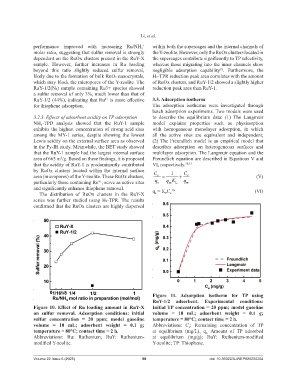
                performance  improved  with  increasing  Ru/NH 4    within both the supercages and the internal channels of
                                                                +
                molar ratio, suggesting that sulfur removal is strongly   the Y-zeolite. However, only the RuOx clusters located in
                dependent on the RuOx clusters present in the RuY-X   the supercages contribute significantly to TP selectivity,
                sample.  However,  further  increases  in  Ru  loading   whereas those migrating into the inner channels show
                beyond this ratio slightly reduced sulfur removal,   negligible  adsorption capability .  Furthermore,  the
                                                                                                  18
                likely due to the formation of bulk RuO₂ nanocrystals,   H₂-TPR reduction peak area correlates with the amount
                which may block the micropores of the Y-zeolite. The   of RuOx clusters, and RuY-1/2 showed a slightly higher
                RuY-1/2(N₂) sample containing Ru3+ species showed   reduction peak area than RuY-1.
                a sulfur removal of only 3%, much lower than that of
                RuY-1/2 (44%), indicating that Ru⁴⁺ is more effective   3.3. Adsorption isotherm
                for thiophene adsorption.                           The  adsorption  isotherms  were  investigated  through
                                                                    batch adsorption experiments. Two models were used
                3.2.3. Effects of adsorbent acidity on TP adsorption  to  describe  the  equilibrium  data:  (1)  The  Langmuir
                NH -TPD  analysis  showed  that  the  RuY-1  sample   model  explains properties  such as physisorption
                   3
                exhibits the highest concentration of strong acid sites   with  homogeneous  monolayer  adsorption,  in  which
                among  the  MY-1  series,  despite  showing  the  lowest   all  the  active  sites  are  equivalent  and  independent;
                Lewis acidity on the external surface area as observed   (2) The  Freundlich  model  is  an  empirical  model  that
                in the Py-IR study. Meanwhile, the BET study showed   describes  adsorption  on heterogeneous  surfaces and
                that the RuY-1 sample had the largest internal surface   multilayer adsorption. The Langmuir equation and the
                area of 665 m /g. Based on these findings, it is proposed   Freundlich equation are described in Equations V and
                            2
                that the acidity of RuY-1 is predominantly contributed   VI, respectively. 50,51
                by  RuOx  clusters  located  within  the  internal  surface   C   C
                area (micropores) of the Y-zeolite. These RuOx clusters,   e    1    e                          (V)
                particularly those containing Ru⁴⁺, serve as active sites   q e  q K L  q m
                                                                           m
                and significantly enhance thiophene removal.        q  = K C  1/n                                (VI)
                  The  distribution  of  RuOx  clusters  in  the  RuY-X   e  F  e
                series  was  further  studied  using  H₂-TPR.  The  results
                confirmed that the RuOx clusters are highly dispersed


                                                                    Figure  11.  Adsorption isotherm  for  TP  using
                                                                    RuY-1/2  adsorbent.  Experimental  conditions:
                Figure  10.  Effect  of  Ru  loading  amount  in  RuY-X   Initial TP concentration = 20 ppm; model gasoline
                on sulfur removal.  Adsorption conditions: initial   volume  =  10  mL;  adsorbent  weight  =  0.1  g;
                sulfur  concentration  =  20  ppm;  model  gasoline   temperature = 80°C; contact time = 2 h.
                volume  =  10  mL;  adsorbent  weight  =  0.1  g;   Abbreviations:  C : Remaining  concentration  of  TP
                                                                                    e
                temperature = 80°C; contact time = 2 h.             at  equilibrium  (mg/L),  q   Amount  of  TP adsorbed
                                                                                            e:
                Abbreviations:  Ru: Ruthenium;  RuY: Ruthenium-     at  equilibrium  (mg/g);  RuY:  Ruthenium-modified
                modified Y-zeolite.                                 Y-zeolite; TP: Thiophene.


                Volume 22 Issue 6 (2025)                        98                           doi: 10.36922/AJWEP025250204

