


Page 102 - AJWEP-22-6
P. 102
Li, et al.

                the  micropore  channels  of  Y-zeolite.  Therefore,  the   acid intensity and the lowest Lewis acidity for RuY-1.
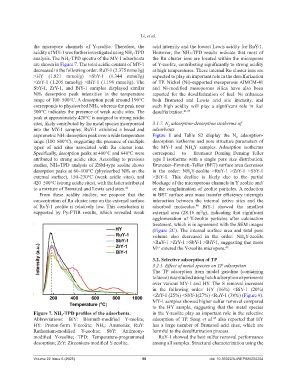
                acidity of MY-1 was further investigated using NH -TPD   However,  the  NH₃-TPD  results  indicate  that  most  of
                                                           3
                analysis. The NH -TPD spectra of the MY-1 adsorbents   the Ru cluster ions are located within the micropores
                               3
                are shown in Figure 7. The total acidic content of MY-1   of Y-zeolite, contributing significantly to strong acidity
                decreased in the following order: RuY-1 (2.375 mmol/g)   at high temperatures. These internal Ru cluster ions are
                >HY (1.821 mmol/g)  >SbY-1  (1.344 mmol/g)          expected to play an important role in the desulfurization
                >ZrY-1  (1.205  mmol/g)  >BiY-1  (1.196  mmol/g). The   of TP. Nickel (Ni)-supported mesoporous AlMCM-41
                SbY-1,  ZrY-1,  and  BiY-1  samples  displayed  similar   and  Ni-modified  mesoporous  silica  have  also  been
                NH₃  desorption  peak  intensities  in  the  temperature   reported for the desulfurization of fuel. Ni enhances
                range of 100–500°C. A desorption peak around 190°C   both  Brønsted  and  Lewis  acid  site  intensity,  and
                corresponds to physisorbed NH₃, whereas the peak near   such  high  acidity  will  play  a  significant  role  in  fuel
                300°C indicates the presence of weak acidic sites. The   desulfurization. 21,47
                peak at approximately 420°C is assigned to strong acidic
                sites, likely contributed by the metal species incorporated   3.1.7. N  adsorption-desorption isotherms of
                                                                           2
                into the MY-1  samples. RuY-1 exhibited a broad and   adsorbents
                asymmetric NH₃ desorption peak over a wide temperature   Figure  8 and  Table S2 display  the  N  adsorption-
                                                                                                         2
                range (100–800°C), suggesting the presence of multiple   desorption isotherms and pore structure parameters of
                types  of  acid  sites  associated  with  Ru  cluster  ions.   the MY-1 and NH Y samples.  Adsorption isotherms
                                                                                      4
                Specifically, desorption peaks at 400°C and 640°C were   correspond   to   Brunauer–Deming–Deming–Teller
                attributed to strong acidic sites. According to previous   type  I  isotherms  with  a  single  pore  size  distribution.
                studies,  NH₃-TPD  analysis  of  ZSM-type  zeolite  shows   Brunauer–Emmett–Teller (BET) surface area decreases
                desorption peaks at 60–100°C (physisorbed NH₃ on the   in the order: NH Y-zeolite  >RuY-1  >ZrY-1  >SbY-1
                                                                                     4
                external  surface),  150–230°C  (weak  acidic  sites),  and   >BiY-1.  This  decline  is  likely  due  to  the  partial
                420–500°C (strong acidic sites), with the latter attributed   blockage of the microporous channels in Y zeolite and/
                to a mixture of Brønsted and Lewis acid sites. 46   or the conglutination  of zeolite  particles. A  reduction
                  From  these  acidity  studies,  we  propose  that  the   in BET surface area mass transfer efficiency interrupts
                concentration of Ru cluster ions on the external surface   interaction  between  the  internal  active  sites  and  the
                of RuY-1 zeolite is relatively low. This conclusion is   adsorbed molecules.   BiY-1  showed  the  smallest
                                                                                       48
                supported  by  Py-FTIR  results,  which  revealed  weak   external  area  (28.16 m /g),  indicating  that  significant
                                                                                         2
                                                                    agglomeration  of  Y-zeolite  particles  after  calcination
                                                                    treatment, which is in agreement with the SEM images
                                                                    (Figure  2C). The internal  surface area and total  pore
                                                                    volume  also decreased  in the  order:  NH Y-zeolite
                                                                                                            4
                                                                    >RuY-1 >ZrY-1 >SbY-1 >BiY-1, suggesting that more
                                                                    M  entered the Y-zeolite micropore. 49
                                                                      n+
                                                                    3.2. Selective adsorption of TP
                                                                    3.2.1. Effect of metal species on TP adsorption
                                                                    The  TP adsorption from model gasoline (containing
                                                                    toluene) was studied using batch adsorption experiments
                                                                    over various MY-1 and HY. The S removal increases
                                                                    in  the  following  order:  HY  (16%)  <BiY-1  (20%)
                                                                    <ZrY-1 (25%) <SbY-1(27%) <RuY-1 (38%) (Figure 9).
                                                                    MY-1 samples showed higher sulfur removal compared
                                                                    to  the  HY sample,  suggesting  that  the  metal  species
                Figure 7. NH -TPD profiles of the adsorbents.       in the Y-zeolite play an important role in the selective
                            3
                Abbreviations:  BiY:  Bismuth-modified  Y-zeolite;   adsorption of TP. Song et al.  also reported that HY
                                                                                               45
                HY: Proton-form  Y-zeolite;  NH : Ammonia;  RuY:    has a large number of Brønsted acid sites, which are
                                              3
                Ruthenium-modified  Y-zeolite;  SbY:  Antimony-     harmful to the desulfurization process.
                modified  Y-zeolite;  TPD:  Temperature-programmed     RuY-1 showed the best sulfur removal performance
                desorption; ZrY: Zirconium-modified Y-zeolite.      among all samples. Structural characterization using the


                Volume 22 Issue 6 (2025)                        96                           doi: 10.36922/AJWEP025250204

