


Page 98 - AJWEP-22-6
P. 98
Li, et al.

                Bi O at the (012) plane (JCPDF No.: 41-1449), ZrO      The  XRD  patterns  of  the  Ru-modified  zeolites
                    3
                                                                2
                  2

                at the (111) plane (JCPDF No.: 37-1484), and RuO  at   with varying initial molar ratios of Ru to ammonium
                                                              2
                the (101) and (110) planes (JCPDF No.: 43-1027) were   ion  (Ru/NH₄⁺)  are  shown  in  Figure S2.  All samples
                observed. Interestingly, SbY-1 did not show detectable   exhibited  characteristic  peaks  of Y-zeolite  along  with
                diffraction peaks corresponding to Sb oxide. However,   the RuO₂ phase. As the Ru/NH₄⁺ ratio decreased, the
                energy-dispersive X-ray spectroscopy (EDX) analysis   intensity of the RuO₂ diffraction peaks also diminished,
                (Figure S1B) confirmed the presence of Sb elements,   indicating  reduced  loading  of  bulk  RuO₂  with  lower
                suggesting a high degree of homogeneity and dispersion   initial Ru content.
                of Sb within the Y-zeolite matrix.
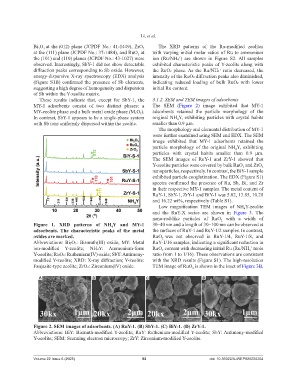
                  These  results  indicate  that,  except  for  SbY-1,  the   3.1.2. SEM and TEM images of adsorbents
                MY-1  adsorbents  consist  of  two  distinct  phases:  a   The  SEM (Figure  2) image  exhibited  that  MY-1
                MY-zeolite phase and a bulk metal oxide phase (MₓOᵧ).   adsorbents retained  the particle  morphology of the
                In contrast, SbY-1 appears to be a single-phase system   original NH Y, exhibiting particles with crystal habits
                                                                               4
                with Sb ions uniformly dispersed within the zeolite.  smaller than 0.9 µm.
                                                                       The morphology and elemental distribution of MY-1
                                                                    were further examined using SEM and EDX. The SEM
                                                                    image  exhibited  that  MY-1 adsorbents retained  the
                                                                    particle  morphology of the original  NH Y, exhibiting
                                                                                                         4
                                                                    particles  with  crystal  habits  smaller  than  0.9  µm.
                                                                    The  SEM  images  of  RuY-1  and  ZrY-1  showed  that
                                                                    Y-zeolite particles were covered by bulk RuO  and ZrO
                                                                                                                    2
                                                                                                            2
                                                                    nanoparticles, respectively. In contrast, the BiY-1 sample
                                                                    exhibited particle conglutination. The EDX (Figure S1)
                                                                    spectra confirmed the presence of Ru, Sb, Bi, and Zr
                                                                    in their respective MY-1 samples. The metal content of
                                                                    RuY-1, SbY-1, ZrY-1 and BiY-1 was 5.02, 13.85, 10.28
                                                                    and 16.22 wt%, respectively (Table S1).
                                                                       Low  magnification  TEM  images  of  NH Y-zeolite
                                                                                                            4
                                                                    and  the  RuY-X  series  are  shown  in  Figure  3. The
                                                                    nano-rod-like  particles  of  RuO   with  a  width  of
                                                                                                  2
                Figure  1. XRD patterns of NH Y  and  MY-1          30–40 nm and a length of 30–100 nm can be observed at
                                                  4
                adsorbents.  The  characteristic  peaks of  the metal   the surfaces of RuY-1 and RuY-1/2 samples. In contrast,
                oxides are marked.                                  RuO was  not  observed  in  RuY-1/4,  RuY-1/8,  and
                                                                        2
                Abbreviations: Bi₂O₃: Bismuth(III) oxide; MY: Metal   RuY-1/16 samples, indicating a significant reduction in
                ion-modified  Y-zeolite;  NH₄Y:  Ammonium-form      RuO  content with decreasing initial Ru (Ru/NH  mole
                                                                                                               +
                                                                                                               4
                                                                        2
                Y-zeolite; RuO₂: Ruthenium(IV) oxide; SbY: Antimony-  ratio from 1 to 1/16). These observations are consistent
                modified Y-zeolite; XRD: X-ray diffraction; Y-zeolite:   with the XRD results (Figure S1). The high-resolution
                Faujasite-type zeolite; ZrO₂: Zirconium(IV) oxide.  TEM image of RuO  is shown in the inset of Figure 3B,
                                                                                      2
                  A                       B                      C                        D


                Figure 2. SEM images of adsorbents. (A) RuY-1. (B) SbY-1. (C) BiY-1. (D) ZrY-1.
                Abbreviations: BiY: Bismuth-modified Y-zeolite; RuY: Ruthenium-modified Y-zeolite; SbY: Antimony-modified
                Y-zeolite; SEM: Scanning electron microscopy; ZrY: Zirconium-modified Y-zeolite.


                Volume 22 Issue 6 (2025)                        92                           doi: 10.36922/AJWEP025250204

