


Page 100 - AJWEP-22-6
P. 100
Li, et al.

                532.1eV corresponding to Sb  of Sb O , indicating the   A
                                          5+
                                                   5
                                                2
                coexistence of Sb and Sb  in the SbY-1 sample.  The
                                                           36
                                       5+
                               3+
                peak area of Sb  is smaller than that of Sb , indicating
                             5+
                                                     3+
                that the Sb(III)Y in the SbY-1 is the dominant phase.
                  In the Zr 3d spectrum, peaks at 182.5 eV (3d ) and    B
                                                          5/2
                185 eV (3d ) are attributed to Zr  for the ZrOCl ·8H O
                                             4+
                                                          2
                         3/2
                                                              2
                and  bulk  ZrO .   The  peaks  at  182.7  eV  (3d ) and
                              37
                                                          5/2
                             2
                185.2eV(3d )  for  the  ZrY-1  are  shifted  slightly  by   C
                          3/2
                0.2eV toward higher binding energy, and are attributed
                to  Zr .  Similar  to  RuY-1,  the  Zr  species may exist
                    4+
                                              4+
                as ZrOₓ cluster ions in ZrY-1. In the Bi 4f spectrum of
                BiY-1, the peaks at 159.8 eV (4f ) and 165.2 eV (4f )   D
                                            7/2
                                                              5/2
                are attributed  to  Bi ,  consistent  with  Bi(NO ) ·5H O
                                 3+
                                                              2
                                                         3 3

                and BiOCl references. 38
                  These  findings  indicate  oxidation  of  the  metal
                species occurred in the RuY-1and SbY-1  samples
                during the calcinations at 500°C, but not in the ZrY-1
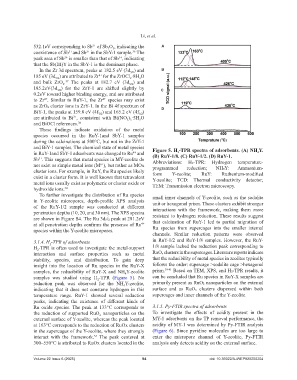
                and BiY-1 samples. The chemical state of metal species   Figure 5. H -TPR spectra of adsorbents. (A) NH Y.
                in RuY-1and SbY-1 adsorbents was changed to Ru  and   (B) RuY-1/8. (C) RuY-1/2. (D) RuY-1.        4
                                                                               2
                                                            4+
                Sb . This suggests that metal species in MY-zeolite do   Abbreviations:  H₂-TPR:  Hydrogen  temperature-
                  5+
                not exist as simple metal ions (M ), but rather as MOx   programmed   reduction;   NH₄Y:   Ammonium-
                                             n+
                cluster ions. For example, in RuY, the Ru species likely   form   Y-zeolite;   RuY:   Ruthenium-modified
                exist in a cluster form. It is well known that tetravalent   Y-zeolite;  TCD:  Thermal  conductivity  detector;
                metal ions usually exist as polymeric or cluster oxide or   TEM: Transmission electron microscopy.
                hydroxide ions. 34
                  To further investigate the distribution of Ru species   small inner channels of Y-zeolite, such as the sodalite
                in  Y-zeolite  micropores,  depth-profile  XPS  analysis   unit or hexagonal prism. These clusters exhibit stronger
                of  the  RuY-1/2  sample  was  conducted  at  different   interactions  with  the  framework,  making  them  more
                penetration depths (10, 20, and 30 nm). The XPS spectra   resistant to hydrogen reduction. These results suggest
                are shown in Figure S4. The Ru 3d₅/₂ peak at 281.2eV
                at all penetration depths confirms the presence of Ru    that  calcination  of RuY-1 led  to partial  migration  of
                                                               4+
                species within the Y-zeolite micropores.            Ru  species  from  supercages  into  the  smaller internal
                                                                    channels.  Similar  reduction  patterns  were  observed
                3.1.4. H -TPR of adsorbents                         in  RuY-1/2  and  RuY-1/8  samples.  However,  the  RuY-
                       2
                H -TPR is often used to investigate the metal-support   1/8 sample lacked the reduction peak corresponding to
                 2
                interaction  and surface  properties  such as metal   RuOₓ clusters in the supercages. Literature reports indicate
                stability, species, and distribution.  To gain deep   that the reducibility of metal species in zeolites typically
                insight into the location  of Ru species in the RuY-X   follows the order: supercage >sodalite cage >hexagonal
                samples, the reducibility  of RuY-X and NH Y-zeolite   prism. 39-41  Based on TEM, XPS, and H₂-TPR results, it
                                                        4
                samples  was  studied  using  H -TPR (Figure  5). No   can be concluded that Ru species in RuY-X samples are
                                            2
                reduction  peak  was  observed  for  the  NH Y-zeolite,   primarily present as RuO₂ nanoparticles on the external
                                                       4
                indicating  that  it  does  not  consume  hydrogen  in  this   surface  and  as  RuOₓ  clusters  dispersed  within  both
                temperature  range.  RuY-1  showed  several  reduction   supercages and inner channels of the Y-zeolite.
                peaks,  indicating  the  existence  of  different  kinds  of
                Ru  oxide  species. The  peak  at  133°C  corresponds  to   3.1.5. Py-FTIR spectra of adsorbents
                the reduction of supported RuO  nanoparticles on the   To  investigate  the  effects  of  acidity  present  in  the
                                             2
                external surface of Y-zeolite, whereas the peak located   MY-1 adsorbents on the TP removal performance, the
                at 163°C corresponds to the reduction of RuOx clusters   acidity of MY-1 was determined by Py-FTIR analysis
                in the supercages of the Y-zeolite, where they strongly   (Figure  6). Since  pyridine  molecules  are too large to
                interact  with  the  framework.   The  peak  centered  at   enter  the  micropore  channel  of  Y-zeolite,  Py-FTIR
                                          33
                300–550°C is attributed to RuOx clusters located in the   analysis only detects acidity on the external surface.
                Volume 22 Issue 6 (2025)                        94                           doi: 10.36922/AJWEP025250204

