


Page 101 - AJWEP-22-6
P. 101
Adsorption desulfurization

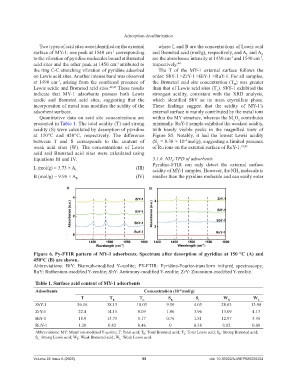
                  Two types of acid sites were identified on the external   where L and B are the concentrations of Lewis acid
                surface of MY-1: one peak at 1540 cm  corresponding   and Brønsted acid (mol/g), respectively, and A  and A
                                                  -1
                                                                                                                    B
                                                                                                             L
                to the vibration of pyridine molecules bound at Brønsted   are the absorbance intensity at 1450 cm  and 1540 cm ,
                                                                                                                   -1
                                                                                                       -1
                acid sites and the other peak at 1450 cm attributed to   respectively. 44
                                                    -1
                the ring C-C stretching vibration of pyridine adsorbed   The  T  of  the  MY-1  external  surface  follows  the
                on Lewis acid sites. Another intense band was observed   order: SbY-1 >ZrY-1 >BiY-1 >RuY-1. For all samples,
                at 1490 cm , arising from the combined presence of   the  Brønsted  acid  site  concentration  (T )  was  greater
                          -1
                                                                                                        B
                Lewis acidic and Brønsted acid sites. 42,43  These results   than that of Lewis acid sites (T ). SbY-1 exhibited the
                                                                                                L
                indicate  that  MY-1  adsorbents  possess  both  Lewis   strongest  acidity,  consistent  with  the  XRD  analysis,
                acidic  and  Brønsted  acid  sites,  suggesting  that  the   which  identified  SbY  as  its  main  crystalline  phase.
                incorporation of metal ions modifies the acidity of the   These  findings  suggest  that  the  acidity  of  MY-1’s
                adsorbent surfaces.                                 external surface is mainly contributed by the metal ions
                  Quantitative data on acid site concentrations are   within the MY structure, whereas the M O  contributes
                                                                                                        x
                                                                                                          y
                presented in Table 1. The total acidity (T) and strong   minimally. RuY-1 sample exhibited the weakest acidity,
                acidity (S) were calculated by desorption of pyridine   with  barely  visible  peaks  in  the  magnified  view  of
                at  150°C  and  450°C,  respectively.  The  difference   Figure  S5.  Notably,  it  had  the  lowest  Lewis  acidity
                between  T  and  S  corresponds  to  the  content  of   (S  = 0.38 × 10 mol g), suggesting a limited presence
                                                                                       /
                                                                                  -4
                                                                      L
                weak  acid  sites  (W).  The  concentrations  of  Lewis   of Ru ions on the external surface of RuY-1. 19,45
                acid  and  Brønsted  acid  sites  were  calculated  using
                Equations III and IV.                               3.1.6. NH -TPD of adsorbents
                                                                             3
                L (mol/g) = 3.73 × A L                       (III)  Pyridine-FTIR  can  only  detect  the  external  surface
                                                                    acidity of MY-1 samples. However, the NH  molecule is
                                                                                                          3
                B (mol/g) = 9.90 × A B                       (IV)   smaller than the pyridine molecule and can easily enter
                              A                                    B


                Figure 6. Py-FTIR pattern of MY-1 adsorbents. Spectrum after desorption of pyridine at 150 °C (A) and
                450°C (B) are shown.
                Abbreviations:  BiY:  Bismuth-modified  Y-zeolite;  PY-FTIR:  Pyridine-Fourier-transform  infrared  spectroscopy;
                RuY: Ruthenium-modified Y-zeolite; SbY: Antimony-modified Y-zeolite; ZrY: Zirconium-modified Y-zeolite.

                 Table 1. Surface acid content of MY-1 adsorbents
                 Adsorbents                                     Concentration (10 mol/g)
                                                                                ‑4
                                     T           T B          T L          S B         S L         W B          W L
                 SbY-1             56.16        38.13        18.03        9.50        4.05         28.63        13.98
                 ZrY-1              22.4        14.15         8.09        1.06        3.96         13.09        4.13
                 BiY-1              18.9        13.73         5.17        0.76        1.81         12.97        3.36
                 RuY-1              1.28         0.82         0.46          0         0.38         0.82         0.08
                 Abbreviations: MY: Metal ion-modified Y-zeolite; T: Total acid; T B : Total Brønsted acid; T L : Total Lewis acid; S B : Strong Brønsted acid;
                 S L : Strong Lewis acid; W B : Weak Brønsted acid; W L : Weak Lewis acid.


                Volume 22 Issue 6 (2025)                        95                           doi: 10.36922/AJWEP025250204

