


Page 103 - AJWEP-22-6
P. 103
Adsorption desulfurization

                              A                                    B


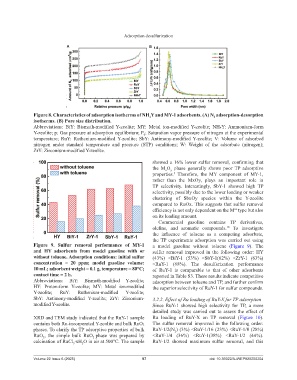
                Figure 8. Characteristics of adsorption isotherms of NH Y and MY-1 adsorbents. (A) N  adsorption‑desorption
                                                                                               2
                                                                   4
                isotherms. (B) Pore size distribution.
                Abbreviations:  BiY:  Bismuth-modified  Y-zeolite;  MY:  Metal  ion-modified  Y-zeolite;  NH₄Y:  Ammonium-form
                Y-zeolite; p: Gas pressure at adsorption equilibrium; P : Saturation vapor pressure of nitrogen at the experimental
                                                                0
                temperature;  RuY:  Ruthenium-modified  Y-zeolite;  SbY:  Antimony-modified  Y-zeolite;  V:  Volume  of  adsorbed
                nitrogen under standard temperature  and pressure (STP) conditions;  W:  Weight of the adsorbate (nitrogen);
                ZrY: Zirconium-modified Y-zeolite.


                                                                    showed  a  16%  lower  sulfur  removal,  confirming  that
                                                                    the  M O   phase  generally  shows  poor  TP  adsorptive
                                                                            y
                                                                          x
                                                                    properties.   Therefore,  the MY component  of MY-1,
                                                                              5
                                                                    rather  than  the  MxOy,  plays  an  important  role  in
                                                                    TP  selectivity.  Interestingly,  SbY-1  showed  high  TP
                                                                    selectivity, possibly due to the lower loading or weaker
                                                                    clustering  of  SbxOy  species  within  the  Y-zeolite
                                                                    compared to RuOx. This suggests that sulfur removal
                                                                    efficiency is not only dependent on the M type but also
                                                                                                        n+
                                                                    on its loading amount.
                                                                       Commercial  gasoline contains  TP derivatives,
                                                                    olefins,  and  aromatic  compounds.  To  investigate
                                                                                                     18
                                                                    the  influence  of  toluene  as  a  competing  adsorbate,
                                                                    the  TP  experiments  adsorption  was  carried  out  using
                Figure  9.  Sulfur  removal  performance  of  MY-1   a  model  gasoline  without  toluene  (Figure  9). The
                and  HY  adsorbents  from  model  gasoline  with  or   sulfur  removal  improved  in  the  following  order:  HY
                without toluene. Adsorption conditions: initial sulfur   (43%)  <BiY-1  (53%)  <SbY-1(62%)  <ZrY-1  (63%)
                concentration  =  20  ppm;  model  gasoline  volume:   <RuY-1  (68%).  The  desulfurization  performance
                10 mL; adsorbent weight = 0.1 g, temperature = 80°C;   of RuY-1 is comparable  to that of other adsorbents
                contact time = 2 h.                                 reported in Table S3. These results indicate competitive
                Abbreviations:  BiY:  Bismuth-modified  Y-zeolite;   adsorption between toluene and TP, and further confirm
                HY:  Proton-form  Y-zeolite;  MY:  Metal  ion-modified   the superior selectivity of RuY-1 for sulfur compounds.
                Y-zeolite;   RuY:   Ruthenium-modified   Y-zeolite;
                SbY:  Antimony-modified  Y-zeolite;  ZrY:  Zirconium-  3.2.2. Effect of Ru loading of RuY-X for TP adsorption
                modified Y-zeolite.                                 Since  RuY-1  showed  high  selectivity  for  TP,  a  more
                                                                    detailed  study  was  carried  out  to  assess  the  effect  of
                XRD and TEM study indicated that the RuY-1 sample   Ru loading  of RuY-X on  TP removal  (Figure  10).
                contains both Ru-incorporated Y-zeolite and bulk RuO₂   The  sulfur  removal  improved  in  the  following  order:
                phases. To clarify the TP adsorptive properties of bulk   RuY-1/2(N ) (3%) <RuY-1/16 (23%) <RuY-1/8 (28%)
                                                                              2
                RuO ,  the  simple  bulk  RuO phase  was  prepared  by   <RuY-1/4  (36%)  <RuY-1(38%)  <RuY-1/2  (44%).
                                          2
                    2
                calcination of RuCl ∙xH O in air at 500°C. The sample   RuY-1/2  showed  maximum  sulfur  removal,  and  this
                                 3
                                     2
                Volume 22 Issue 6 (2025)                        97                           doi: 10.36922/AJWEP025250204

