


Page 153 - AJWEP-22-6
P. 153
Water quality of Bharatpur, Nepal

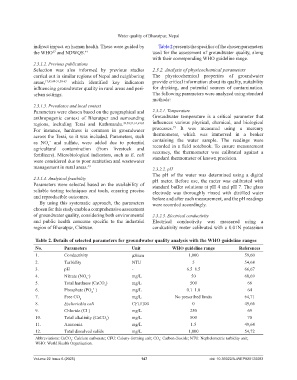
                indirect impact on human health. These were guided by   Table 2 presents the specifics of the chosen parameters
                the WHO  and NDWQS.   44                            used for the assessment of groundwater quality, along
                        57
                                                                    with their corresponding WHO guideline range.
                2.3.1.2. Previous publications
                Selection  was also  informed  by previous studies   2.3.2. Analysis of physicochemical parameters
                carried out in similar regions of Nepal and neighboring   The  physicochemical  properties  of groundwater
                areas, 17,43,49-51,58-63   which  identified  key  indicators   provide critical information about its quality, suitability
                influencing groundwater quality in rural areas and peri-  for drinking,  and potential  sources of contamination.
                urban settings.                                     The following parameters were analyzed using standard
                                                                    methods:
                2.3.1.3. Prevalence and local context
                Parameters were chosen based on the geographical and   2.3.2.1. Temperature
                anthropogenic  context  of Bharatpur  and surrounding   Groundwater temperature  is a critical  parameter  that
                regions, including  Terai and Kathmandu. 39,50,51,61,64,65    influences  various  physical,  chemical,  and  biological
                                                                             73
                For instance, hardness is common in groundwater     processes.  It  was measured  using a  mercury
                across the Terai, so it was included. Parameters, such   thermometer, which was immersed in a beaker
                as NO  and sulfate,  were added  due to potential   containing  the  water  sample.  The  readings  were
                       −
                      3
                agricultural  contamination  (from  livestock  and   recorded in a field notebook. To ensure measurement
                fertilizers). Microbiological indicators, such as E. coli   accuracy, the thermometer  was calibrated  against  a
                were considered due to poor sanitation and wastewater   standard thermometer of known precision.
                management in rural areas. 43                       2.3.2.2. pH
                                                                    The pH of the water was determined  using a digital
                2.3.1.4. Analytical feasibility                     pH meter. Before use, the meter  was calibrated  with
                Parameters were selected based on the availability of   standard buffer solutions at pH 4 and pH 7. The glass
                reliable testing techniques and tools, ensuring precise   electrode  was thoroughly rinsed with distilled  water
                and reproducible outcomes.                          before and after each measurement, and the pH readings
                  By using this systematic  approach, the parameters   were recorded accordingly.
                chosen for this study enable a comprehensive assessment
                of groundwater quality, considering both environmental   2.3.2.3. Electrical conductivity
                and  public  health  concerns  specific  to  the  industrial   Electrical  conductivity  was measured  using a
                region of Bharatpur, Chitwan.                       conductivity meter calibrated with a 0.01N potassium


                 Table 2. Details of selected parameters for groundwater quality analysis with the WHO guideline ranges
                 No.         Parameters                    Unit              WHO guideline range          References
                 1.          Conductivity                  µS/cm                    1,000                    59,60
                 2.          Turbidity                     NTU                        5                      54,68
                 3.          pH                            -                       6.5–8.5                   66,67
                 4.          Nitrate (NO )                 mg/L                      50                      60,69
                                        −
                                       3
                 5.          Total hardness (CaCO )        mg/L                      500                      66
                                               3
                 6.          Phosphate (PO )               mg/L                    0.1–1.0                    64
                                          3−
                                         4
                 7.          Free CO                       mg/L               No prescribed limits           64,71
                                    2
                 8.          Escherichia coli              CFU/100                    0                      49,66
                 9.          Chloride (Cl )                mg/L                      250                      69
                                       −
                 10.         Total alkalinity (CaCO )      mg/L                      500                      70
                                                3
                 11.         Ammonia                       mg/L                      1.5                     49,64
                 12.         Total dissolved solids        mg/L                     1,000                    54,72
                 Abbreviations: CaCO : Calcium carbonate; CFU: Colony-forming unit; CO : Carbon dioxide; NTU: Nephelometric turbidity unit;
                                                                       2
                                3
                 WHO: World Health Organization.

                Volume 22 Issue 6 (2025)                       147                           doi: 10.36922/AJWEP025120083

