


Page 155 - AJWEP-22-6
P. 155
Water quality of Bharatpur, Nepal
2.3.2.11. Ammonia For drinking water, the ideal values (Vi) are
Ammonia concentration was determined using a considered zero for all parameters except pH and
colorimetric method. A 20 mL sample was mixed dissolved oxygen. The ideal pH value is 7.0 (for
56
with 2 mL phenol-nitroprusside solution and 2 mL pure water), with a permissible upper limit of 8.5 (for
reagent B, and then diluted to 25 mL with distilled polluted water). For dissolved oxygen, the ideal value
water. The mixture was kept in a dark place at 25°C is 14.6 mg/L, and the permissible minimum is 5 mg/L.
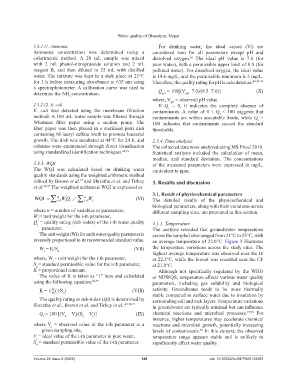
for 1 h before measuring absorbance at 635 nm using Therefore, the quality rating for pH is calculated as: 49,74-76
a spectrophotometer. A calibration curve was used to
determine the NH concentration. Q = 100[(V −7.0)∕(8.5−7.0)] (X)
pH
pH
3
where, V = observed pH value.
pH
2.3.2.12. E. coli If Q = 0, it indicates the complete absence of
i
E. coli was detected using the membrane filtration contaminants. A value of 0 < Q < 100 suggests that
i
method. A 100 mL water sample was filtered through contaminants are within acceptable limits, while Q >
i
Whatman filter paper using a suction pump. The 100 indicates that contaminants exceed the standard
filter paper was then placed in a sterilized petri dish thresholds.
containing M-lauryl sulfate broth to promote bacterial
growth. The dish was incubated at 44°C for 24 h, and 2.3.4. Data analysis
colonies were enumerated through direct visualization The collected data were analyzed using MS Excel 2010.
using standardized identification techniques. 64,71 Statistical analysis included the calculation of mean,
median, and standard deviation. The concentrations
2.3.3. WQI of the measured parameters were expressed in mg/L,
The WQI was calculated based on drinking water equivalent to ppm.
quality standards using the weighted arithmetic method
refined by Brown et al. and Shrestha et al. and Tirkey 3. Results and discussion
74
et al. 49,75 The weighted arithmetic WQI is expressed as:
WQI n i 1 WQ n i 1 W i (VI) 3.1. Result of physicochemical parameters
The detailed results of the physicochemical and
i
i
biological parameters, along with their variations across
where n = number of variables or parameters, different sampling sites, are presented in this section.
W = unit weight for the i-th parameter,
i
Q = quality rating (sub-index) of the i-th water quality 3.1.1. Temperature
i
parameter. The analysis revealed that groundwater temperatures
The unit weight (Wi) for each water quality parameter is across the sampled sites ranged from 21°C to 23°C, with
inversely proportional to its recommended standard value. an average temperature of 22.0°C. Figure 3 illustrates
W = K/S (VII) the temperature variations across the study sites. The
i n highest average temperature was observed near the IF
where, W = unit weight for the i-th parameter, at 22.3°C, while the lowest was recorded near the CF
i
S = standard permissible value for the i-th parameter, at 21.8°C.
n
K = proportional constant. Although not specifically regulated by the WHO
The value of K is taken as “1” here and calculated or NDWQS, temperature affects various water quality
using the following equation: 49,75 parameters, including gas solubility and biological
K = 1∕∑(1∕S ) (VIII) activity. Groundwater tends to be more thermally
n stable compared to surface water due to insulation by
The quality rating or sub-index (Qi) is determined by surrounding soil and rock layers. Temperature variations
Shrestha et al., Brown et al. and Tirkey et al.: 49,74,75 in groundwater are typically minimal but can influence
Q = 100 [(V − V)∕(S − V)] (IX) chemical reactions and microbial processes. 77,78 For
i 0 i n i
instance, higher temperatures may accelerate chemical
where V = observed value of the i-th parameter at a reactions and microbial growth, potentially increasing
o
given sampling site, levels of contaminants. In this context, the observed
79
V = ideal value of the i-th parameter in pure water, temperature range appears stable and is unlikely to
i
S = standard permissible value of the i-th parameter. significantly affect water quality.
n
Volume 22 Issue 6 (2025) 149 doi: 10.36922/AJWEP025120083

