


Page 154 - AJWEP-22-6
P. 154
Yadav, et al.

                chloride standard solution. The electrode was cleaned   weighing the remaining solid residue. The weight of the
                and  rinsed with  distilled  water  before  and  after   empty basin (W ) and the final weight after evaporation
                                                                                  1
                immersion in the sample. Conductivity readings were   (W ) were used to calculate the TDS concentration: 64,71
                                                                       2
                taken once the values stabilized.
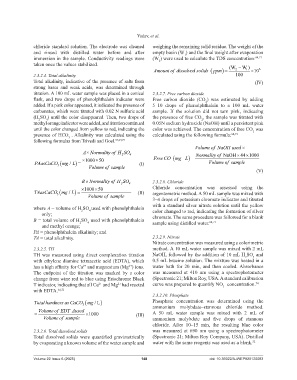
                                                                     Amount of dissolved solids ppm      ( W   W ) 10
                                                                                                                   6
                                                                                                             1
                                                                                                         2
                2.3.2.4. Total alkalinity                                                                100
                Total alkalinity, indicative of the presence of salts from                                       (IV)
                strong  bases  and  weak  acids,  was  determined  through
                titration. A 100 mL water sample was placed in a conical   2.3.2.7. Free carbon dioxide
                flask,  and  two  drops  of  phenolphthalein  indicator  were   Free carbon dioxide  (CO ) was estimated  by adding
                                                                                           2
                added. If a pink color appeared, it indicated the presence of   5–10 drops of phenolphthalein  to a 100  mL water
                carbonates, which were titrated with 0.02 N sulfuric acid   sample. If the solution did not turn pink, indicating
                (H SO ) until the color disappeared. Then, two drops of   the presence of free CO , the sample was titrated with
                  2
                     4
                                                                                          2
                methyl orange indicator were added, and titration continued   0.05N sodium hydroxide (NaOH) until a persistent pink
                until the color changed from yellow to red, indicating the   color was achieved. The concentration of free CO  was
                                                                                                                2
                presence of HCO . Alkalinity was calculated using the   calculated using the following formula: 64,71
                                −
                               3
                following formulas from Trivedi and Goel. 52,64,71
                                                                                       Volume of  NaOH used ×
                                      ANormality of HSO   4                            Normality of   NaOH 44 1000×  ×
                                       ×
                                                       2
                PAasCaCOmgL/      =  ×1000×50                (I)    Free CO  (mg L )        Volume of  sample


                          3             Volume of samplle                                                         (V)
                                     BNormality of HSO  2  4       2.3.2.8. Chloride

                TAasCaCO mg L       1000 50               (II)  Chloride  concentration  was assessed using  the
                               /
                                        Volume of samplle           3–4 drops of potassium chromate indicator and titrated
                          3                                         argentometric method. A 50 mL sample was mixed with
                                                                    with a standard silver nitrate solution until the yellow
                where A = volume of H SO used with phenolphthalein
                                        4
                                     2
                   only;                                            color changed to red, indicating the formation of silver
                B = total volume of H SO  used with phenolphthalein   chromate. The same procedure was followed for a blank
                                                                                             64,71
                                        4
                                    2
                   and methyl orange;                               sample using distilled water.
                PA = phenolphthalein alkalinity; and
                TA = total alkalinity.                              2.3.2.9. Nitrate
                                                                    Nitrate concentration was measured using a colorimetric
                2.3.2.5. TH                                         method. A 10 mL water sample was mixed with 2 mL
                TH was measured using direct complexation titration   NaOH, followed by the addition of 10 mL H SO  and
                                                                                                             2
                                                                                                                4
                with ethylene diamine tetraacetic acid (EDTA), which   0.5 mL brucine solution. The mixture was heated in a
                has a high affinity for Ca  and magnesium (Mg ) ions.   water bath for 20  min, and then  cooled. Absorbance
                                                          2+
                                      2+
                The endpoint of the titration  was marked by a color   was measured at  410  nm  using a spectrophotometer
                change from wine red to blue using Eriochrome Black   (Spectronic 21; Milton Roy, USA. A standard calibration
                                                                                                    −
                T indicator, indicating that all Ca  and Mg had reacted   curve was prepared to quantify NO  concentration. 74
                                            2+
                                                     2+
                                                                                                   3
                with EDTA. 64,71
                                                                    2.3.2.10. Phosphate
                Total hardness as CaCO mg /L                       Phosphate concentration  was determined  using the

                                     3
                  Volume of EDT Aused                               ammonium  molybdate–stannous  chloride method.
                                      1000                 (III)  A  50  mL water sample was mixed with 2  mL of
                    Volume of ssample                               ammonium  molybdate  and  five  drops  of  stannous
                                                                    chloride.  After 10–15  min, the resulting  blue color
                2.3.2.6. Total dissolved solids                     was measured at  690  nm  using a spectrophotometer
                Total dissolved solids were quantified gravimetrically   (Spectronic 21; Milton Roy Company, USA). Distilled
                by evaporating a known volume of the water sample and   water with the same reagents was used as a blank. 52

                Volume 22 Issue 6 (2025)                       148                           doi: 10.36922/AJWEP025120083

