


Page 157 - AJWEP-22-6
P. 157
Water quality of Bharatpur, Nepal

                                                                    investigations 11,87-89  have shown that adequate alkalinity
                                                                    prevents  corrosive  water  conditions  and  supports
                                                                    the  effectiveness  of  water  treatment  processes.
                                                                                                                    90
                                                                    The  observed  values  indicate  a  sufficient  buffering
                                                                    capacity in the groundwater, supporting its stability and
                                                                    suitability for drinking.

                                                                    3.1.5. TH
                                                                    The average TH measured at the IF, RPF, and CF was
                                                                    137 mg/L, 221 mg/L, and 276 mg/L, respectively, as
                                                                    shown in Figure 7. The TH ranged between 99 mg/L and
                                                                    405 mg/L, with the highest value recorded at 405 mg/L
                                                                    in Sample  K near the CF and the lowest hardness at
                                                                    99 mg/L in Sample C near the IF.
                                                                       Water hardness traditionally refers to how well
                                                                    water reacts with soap, with hard water requiring a
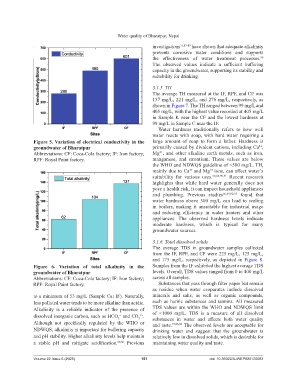
                Figure 5. Variation of electrical conductivity in the   large amount of soap to form a lather. Hardness is
                groundwater of Bharatpur                            primarily caused by divalent cations, including Ca ,
                                                                                                                   2+
                                                                       2+
                Abbreviations: CF: Coca-Cola factory; IF: Iron factory;   Mg , and other alkaline earth metals, such as iron,
                RPF: Royal Paint factory.                           manganese, and strontium.  These values are below
                                                                    the WHO and NDWQS guideline of <500 mg/L. TH,
                                                                    mainly due to Ca and Mg ions, can affect water’s
                                                                                    2+
                                                                                             2+
                                                                    suitability for various uses. 50,60,90,91   Recent  research
                                                                    highlights that while hard water generally does not
                                                                    pose a health risk, it can impact household appliances
                                                                    and  plumbing. Previous  studies 66,69,92,93  found  that
                                                                    water hardness above 300 mg/L can lead to scaling
                                                                    in boilers, making it unsuitable for industrial usage
                                                                    and  reducing  efficiency  in  water  heaters  and  other
                                                                    appliances.  The  observed  hardness levels  indicate
                                                                    moderate hardness, which is typical for many
                                                                    groundwater sources.

                                                                    3.1.6. Total dissolved solids
                                                                    The  average  TDS in groundwater  samples  collected
                                                                    from the IF, RPF, and CF were 225 mg/L, 125 mg/L,
                                                                    and 175  mg/L, respectively, as depicted in  Figure  8.
                Figure  6.  Variation  of total alkalinity  in the   Samples from the IF exhibited the highest average TDS
                groundwater of Bharatpur                            levels. Overall, TDS values ranged from 0 to 400 mg/L
                Abbreviations: CF: Coca-Cola factory; IF: Iron factory;   across all samples.
                RPF: Royal Paint factory.                              Substances that pass through filter paper but remain
                                                                    as residue when water evaporates include  dissolved
                to a minimum of 53 mg/L (Sample Cat IF). Naturally,   minerals and salts, as well as organic compounds,
                less polluted water tends to be more alkaline than acidic.   such as humic  substances  and tannins. All measured
                Alkalinity is a reliable  indicator of the presence of   TDS values are within the  WHO and NDWQS limit
                dissolved inorganic carbon, such as HCO  and CO .   of <1000  mg/L.  TDS is a  measure  of all  dissolved
                                                               2−
                                                      −
                                                                    substances  in  water  and  affects  both  water  quality
                                                     3
                                                              3
                Although  not  specifically  regulated  by  the  WHO  or   and taste. 57,66,80  The observed levels are acceptable for
                NDWQS, alkalinity is important for buffering capacity   drinking water and suggest that the groundwater is
                and pH stability. Higher alkalinity levels help maintain   relatively low in dissolved solids, which is desirable for
                a  stable  pH  and  mitigate  acidification. 80,86   Previous   maintaining water quality and taste.

                Volume 22 Issue 6 (2025)                       151                           doi: 10.36922/AJWEP025120083

