


Page 161 - AJWEP-22-6
P. 161
Water quality of Bharatpur, Nepal

                                                                     A                       B


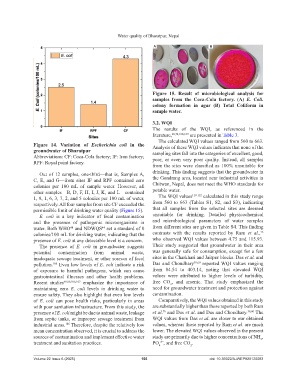
                                                                    Figure  15. Result of microbiological  analysis for
                                                                    samples from the Coca-Cola factory. (A)  E. Coli.
                                                                    colony  formation  in  agar  (B)  Total  Coliform  in
                                                                    sample water.

                                                                    3.2. WQI
                                                                    The  results  of the  WQI, as referenced  in  the
                                                                    literature, 60,74,108,109  are presented in Table 3.
                                                                       The calculated WQI values ranged from 560 to 663.
                Figure  14.  Variation of  Escherichia coli  in the   Analysis of these WQI values indicates that none of the
                groundwater of Bharatpur                            sampling sites fall into the categories of excellent, good,
                Abbreviations: CF: Coca-Cola factory; IF: Iron factory;   poor,  or  even  very  poor  quality.  Instead,  all  samples
                RPF: Royal paint factory.
                                                                    from the sites were classified as 100% unsuitable for
                  Out of 12 samples, one-third—that is, Samples A,   drinking. This finding suggests that the groundwater in
                C,  E,  and  G—from  sites  IF  and  RPF  contained  zero   the Gondrang area, located near industrial activities in
                colonies per 100  mL of sample water. However, all   Chitwan, Nepal, does not meet the WHO standards for
                other samples—B, D, F, H, I, J, K, and L—contained   potable water.
                1, 9, 1, 6, 3, 7, 2, and 5 colonies per 100 mL of water,   The WQI values 110-112  calculated in this study range
                respectively. All four samples from site CF exceeded the   from 560 to 663 (Tables S1, S2, and S3), indicating
                permissible limit of drinking water quality (Figure 15).  that all samples from the selected sites are deemed
                  E. coli is a key indicator  of fecal  contamination   unsuitable for drinking. Detailed physicochemical
                and the presence of pathogenic microorganisms in    and microbiological parameters of water samples
                water. Both WHO  and NDWQS  set a standard of 0     from different sites are given in Table S4. This finding
                                              44
                                48
                                                                                                                    76
                colonies/100 mL for drinking water, indicating that the   contrasts  with  the  results  reported  by  Ram  et al.,
                presence of E. coli at any detectable level is a concern.  who observed WQI values between 4.75 and 115.93.
                  The presence of  E. coli in groundwater suggests   Their study suggested that groundwater in their area
                potential  contamination  from    animal   waste,   was generally safe for consumption, except for a few
                inadequate sewage treatment, or other sources of fecal   sites in the Charkhari and Jaitpur blocks. Das et al. and
                pollution.  Even low levels of E. coli indicate a risk   Das and Choudhary 59,60  reported WQI values ranging
                        106
                of exposure to  harmful  pathogens,  which  can  cause   from 84.54 to 403.14, noting that elevated  WQI
                gastrointestinal  illnesses  and other  health  problems.   values were attributed to higher levels of turbidity,
                Recent  studies 49,89,106,107  emphasize the importance  of   free CO , and arsenic.  That study emphasized the
                                                                            2
                maintaining  zero  E. coli levels  in drinking water to   need for groundwater treatment and protection against
                ensure safety. They also highlight that even low levels   contamination.
                of  E. coli can pose health  risks, particularly  in areas   Comparatively, the WQI values obtained in this study
                with poor sanitation infrastructure. From this study, the   are substantially higher than those reported by both Ram
                presence of E. coli might be due to animal waste, leakage   et al.  and Das et al. and Das and Choudhary. 59,60  The
                                                                         76
                from septic tanks, or improper sewage treatment from   WQI values from Das et al. are closer to our obtained
                industrial areas.  Therefore, despite the relatively low   values, whereas those reported by Ram et al. are much
                              106
                mean concentration observed, it is crucial to address the   lower. The elevated WQI values observed in the present
                sources of contamination and implement effective water   study are primarily due to higher concentrations of NH ,
                                                                                                                    3
                treatment and sanitation practices.                 PO , and free CO .
                                                                        3−
                                                                       4
                                                                                     2
                Volume 22 Issue 6 (2025)                       155                           doi: 10.36922/AJWEP025120083

