


Page 164 - AJWEP-22-6
P. 164
Yadav, et al.

                                                                    that increased dissolved minerals (ions) contribute  to
                                                                    both parameters. The correlation between conductivity
                                                                    and total alkalinity was also strong (r = 0.997, p=0.000),
                                                                    likely due to the presence of CO  and HCO , which
                                                                                                  2−
                                                                                                              −
                                                                                                  3
                                                                                                             3
                                                                    contribute to both alkalinity and conductivity. A strong
                                                                    positive correlation was observed between conductivity
                                                                    and free CO  (r = 0.980, p=0.003), signifying that CO
                                                                               2
                                                                                                                    2
                                                                    dissolution increases ion concentration, thus enhancing
                                                                    conductivity  through  the  formation  of  carbonic  acid
                                                                    or HCO . Moreover, Cl  showed a  strong positive
                                                                            −
                                                                                           −
                                                                            3
                                                                    correlation  with conductivity  (r = 0.989,  p=0.001),
                                                                    consistent with the fact that Cl  is highly conductive
                                                                                                 −
                                                                    in  water.  Similarly,  a  significant  correlation  existed
                                                                    between  conductivity  and  NH₃  (r = 0.971,  p=0.006),
                                                                    showing that  NH increases  conductivity  by forming
                                                                                    3
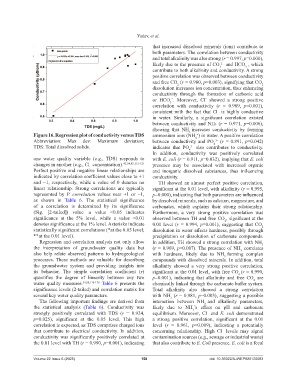
                Figure 16. Regression plot of conductivity versus TDS  ammonium ions (NH ) in water. A positive correlation
                                                                                        +
                                                                                       4
                Abbreviation:  Max dev: Maximum deviation;          between conductivity and PO  (r = 0.891, p=0.042)
                                                                                                3−
                                                                                               4
                TDS: Total dissolved solids.                        indicates  that PO  also contributes to conductivity.
                                                                                     3−
                                                                                    4
                                                                    In addition,  conductivity  was positively  correlated
                one  water quality  variable  (e.g.,  TDS)  responds  to   with E. coli (r = 0.911, p=0.032), implying that E. coli
                changes in another (e.g., Cl  concentration). 43,54,85,115-121    presence  may  be associated  with increased  organic
                                        −
                Perfect positive and negative linear relationships are   and  inorganic  dissolved  substances,  thus  influencing
                indicated by correlation coefficient values close to +1   conductivity.
                and  −1,  respectively,  while  a  value  of  0  denotes  no   TH showed an almost perfect positive correlation,
                linear relationship. Strong correlations are typically   significant at the 0.01 level, with alkalinity (r = 0.995,
                represented by  P. correlation  values  near  +1  or  −1,   p=0.000), indicating that both parameters are influenced
                as shown in  Table  6.  The  statistical  significance   by dissolved minerals, such as calcium, magnesium, and
                of  a  correlation  is  determined  by  its  significance   carbonates,  which explains their strong relationship.
                (Sig. [2-tailed]) value—a  value <0.05  indicates   Furthermore,  a very strong positive  correlation  was
                significance  at  the  5%  level,  while  a  value  <0.01   observed between TH and free CO , significant at the
                                                                                                    2
                denotes significance at the 1% level. Asterisks indicate   0.01 level (r = 0.994,  p=0.001), suggesting that CO
                                                                                                                    2
                statistically significant correlations (*at the 0.05 level;   dissolution in water affects hardness, possibly through
                **at the 0.01 level).                               precipitation  or dissolution  of carbonate  compounds.
                  Regression and correlation analysis not only allow   In addition, TH showed a strong correlation with NH
                                                                                                                    3
                the interpretation of groundwater quality  data but   (r = 0.969, p=0.007). The presence of NH  correlates
                                                                                                           3
                also help  relate  observed patterns  to hydrogeological   with hardness, likely  due to NH forming  complex
                                                                                                    3
                processes. These methods are valuable for describing   compounds with dissolved minerals. In addition, total
                the  groundwater  system  and  providing  insights  into   alkalinity  showed  a very strong positive correlation,
                its  behavior.  The  simple  correlation  coefficient  (r)   significant at the 0.01 level, with free CO (r = 0.990,
                                                                                                          2
                quantifies  the  degree  of  linearity  between  any  two   p=0.001), indicating  that  alkalinity  and free  CO  are
                                                                                                                 2
                water quality measures. 54,85,115-120   Table  6 presents the   chemically linked through the carbonate buffer system.
                significance levels (2-tailed) and correlation matrix for   Total alkalinity  also showed  a strong correlation
                several key water quality parameters.               with NH  (r = 0.981, p=0.003), suggesting a possible
                                                                            3
                  The following important findings are derived from   interaction  between NH and alkalinity  parameters,
                                                                                           3
                the  statistical  analysis  (Table  6). Conductivity  was   likely  due to NH ’s  effect  on  pH  and  carbonate
                                                                                      3
                strongly positively correlated with  TDS (r = 0.924,   equilibrium.  Moreover, Cl   and  E.  coli  demonstrated
                                                                                            −
                p=0.025),  significant  at  the  0.05  level.  This  high   a  strong  positive  correlation,  significant  at  the  0.01
                correlation is expected, as TDS comprises charged ions   level (r = 0.961,  p=0.009), indicating  a potentially
                that  contribute  to  electrical  conductivity.  In addition,   concerning  relationship.  High Cl  levels  may  signal
                                                                                                   −
                conductivity  was  significantly  positively  correlated  at   contamination sources (e.g., sewage or industrial waste)
                the 0.01 level with TH (r = 0.990, p=0.001), indicating   that also contribute to E. Coli presence. E. coli is a fecal


                Volume 22 Issue 6 (2025)                       158                           doi: 10.36922/AJWEP025120083

