


Page 160 - AJWEP-22-6
P. 160
Yadav, et al.

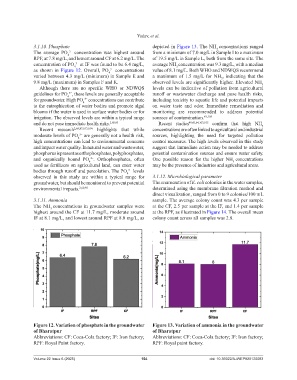
                3.1.10. Phosphate                                   depicted in Figure 13. The NH concentrations ranged
                                                                                                3
                The  average  PO   concentration  was highest  around   from a minimum of 7.0 mg/L in Sample I to a maximum
                               3−
                               4
                RPF, at 7.8 mg/L, and lowest around CF at 6.2 mg/L. The   of 19.5 mg/L in Sample L, both from the same site. The
                concentration of PO  at IF was found to be 6.4 mg/L,   average NH concentration was 9.3 mg/L, with a median
                                  3−
                                                                               3
                                  4
                as shown in  Figure  12. Overall,  PO  concentrations   value of 8.1 mg/L. Both WHO and NDWQS recommend
                                                 3−
                                                 4
                varied between 4.3 mg/L (minimum) in Sample E and   a maximum of 1.5 mg/L for NH , indicating that the
                                                                                                  3
                9.8 mg/L (maximum) in Samples F and K.              observed levels are significantly higher. Elevated NH 3
                  Although  there  are  no  specific  WHO  or  NDWQS   levels can be indicative of pollution from agricultural
                guidelines for PO , these levels are generally acceptable   runoff or wastewater discharge and pose health risks,
                               3−
                               4
                for groundwater. High PO  concentrations can contribute   including toxicity to aquatic life and potential impacts
                                      3−
                                      4
                to the eutrophication of water bodies and promote algal   on water taste and odor. Immediate  remediation  and
                blooms if the water is used in surface water bodies or for   monitoring  are recommended to address potential
                irrigation. The observed levels are within a typical range   sources of contamination. 49,105
                and do not pose immediate health risks. 2,60,93        Recent  studies 49,43,64,103,105   confirm  that  high  NH 3
                  Recent  research 2,69,87,103,104  highlights that while   concentrations are often linked to agricultural and industrial
                moderate levels of PO  are generally not a health risk,   sources, highlighting the need for targeted pollution
                                    3−
                                   4
                high concentrations can lead to environmental concerns   control measures. The high levels observed in this study
                and impact water quality. In natural water and wastewater,   suggest that immediate action may be needed to address
                phosphorus is present as orthophosphates, polyphosphates,   potential contamination sources and ensure water safety.
                and organically bound PO . Orthophosphates, often   One possible reason for the higher NH concentrations
                                         3−
                                        4
                                                                                                       3
                used as fertilizers on agricultural land, can enter water   may be the presence of industries and agricultural areas.
                bodies through runoff and percolation. The PO  levels
                                                          3−
                                                         4
                observed in this study are within a typical range for   3.1.12. Microbiological parameter
                groundwater, but should be monitored to prevent potential   The enumeration of E. coli colonies in the water samples,
                environmental impacts. 2,60,93                      determined using the membrane filtration method and
                                                                    direct visualization, ranged from 0 to 9 colonies/100 mL
                3.1.11. Ammonia                                     sample. The average colony count was 4.3 per sample
                The NH concentrations in groundwater samples were   at the CF, 2.5 per sample at the IF, and 1.4 per sample
                       3
                highest around the CF at 11.7 mg/L, moderate around   at the RPF, as illustrated in Figure 14. The overall mean
                IF at 8.1 mg/L, and lowest around RPF at 8.0 mg/L, as   colony count across all samples was 2.8.


                Figure 12. Variation of phosphate in the groundwater   Figure 13. Variation of ammonia in the groundwater
                of Bharatpur                                        of Bharatpur
                Abbreviations: CF: Coca-Cola factory; IF: Iron factory;   Abbreviations: CF: Coca-Cola factory; IF: Iron factory;
                RPF: Royal Paint factory.                           RPF: Royal paint factory.


                Volume 22 Issue 6 (2025)                       154                           doi: 10.36922/AJWEP025120083

